























THE FIVE-YEAR JACKPOT: FROM RAGS TO RICHES ON THE TAXPAYER’S DIME

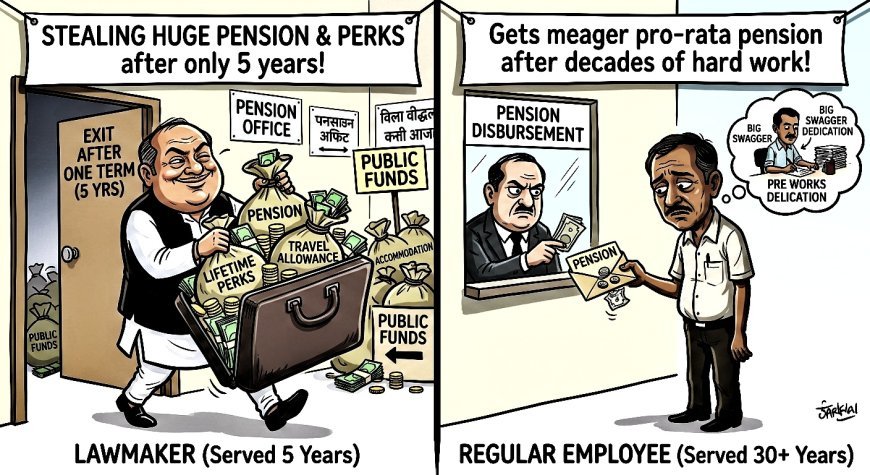
Thirty-Five Years of Sweat vs. Five Years of Swagger
The greatest magic trick in the modern democratic circus is being performed in India without any signs of ending.
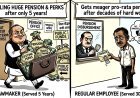
A humble candidate enters the political arena with a torn shirt, empty pockets, and a heart bleeding for the common man. Exactly five years later, this same humble servant of the poor requires a fleet of luxury SUVs to transport his newfound humility. The transformation from a struggling commoner to a filthy-rich aristocrat takes precisely one electoral term. Alchemy is real, and it happens right inside our legislative bodies.
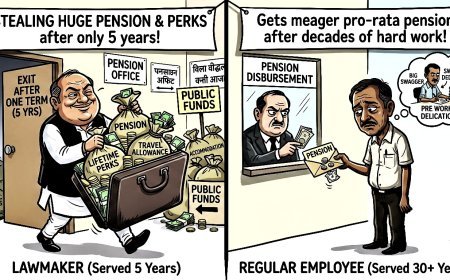
Meanwhile, ordinary citizens spend thirty-five years grinding away at a desk, paying t8axes, and praying for a meagre retirement fund. The State gently pushes these hardworking folks into contributory pension schemes, preaching the noble gospel of fiscal prudence. The message is clear for the masses: you must earn your keep.
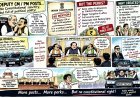
The five-year political VIP, however, secures a guaranteed, unconditional, lifetime claim on the public exchequer. Completing a single term in office has miraculously become the ultimate winning lottery ticket.
The brilliance of this system is unmatched in the corporate world. Employees generally do not vote to increase their own salaries, declare their own lifelong perks, or gift themselves free housing and travel. Lawmakers, however, have perfected the art of extreme self-care at public expense. They mandate severe financial discipline for the public while generously exempting themselves from the austerity they preach.
A rational society requires a reality check. Public office is a temporary trust, not a hereditary monarchy or a lifelong subscription to taxpayer funds. Fair compensation is absolutely necessary during the actual five-year tenure to ensure anyone can afford to serve, but the post-tenure gravy train must stop.
Salaries and pensions must be strictly determined on the basis of actual financial status.
A former lawmaker rolling in newly acquired millions has absolutely no business collecting a state-sponsored pension. Financial security must be reserved for those who genuinely need it, proven by a rigorous, independent audit of their post-power bank accounts. If a former legislator legitimately needs a survival allowance, the State can step in. Otherwise, they can join the rest of the citizenry in the real world of savings, investments, and actual hard work.
The public treasury is not a retirement fund for brief political careers. The republic was built to serve the people, not to sponsor a new class of political nobility. Accountability demands an end to this unconditional lifelong VIP treatment. Public money is simply not political property.
Several developed and developing nations have successfully rejected the culture of lifelong political privilege, holding lawmakers to the same financial realities as ordinary citizens.
Singapore
Despite paying high salaries during active service to attract talent, Singapore completely abolished political pensions in 2012. Lawmakers and ministers no longer receive lifetime payouts. Instead, they contribute to the Central Provident Fund- the exact same contributory retirement scheme mandated for ordinary working citizens.
Sweden
Swedish Members of Parliament called the ‘Riksdag’ do not receive luxurious, lifelong pensions upon losing an election. They are granted a strict, time-limited transition allowance intended solely to support them while they seek normal employment. For long-term retirement, MPs must rely on the standard Swedish public pension system, which is typically accessible at age 66, exactly like their constituents.
Switzerland
Switzerland operates a unique ‘militia parliament’ where serving as a lawmaker is not considered a full-time profession. Swiss politicians hold regular civilian jobs alongside their legislative duties. Consequently, there is no special parliamentary pension system at all. They retire based entirely on their own civilian occupational and state pensions.
Sri Lanka
In a major victory for democratic accountability, a small developing island-country like Sri Lanka passed legislation to completely abolish parliamentary pensions in February 2026. Following intense economic crises and public protests, the government scrapped the law that previously granted lifetime pensions to lawmakers who served just a single five-year term, establishing a powerful precedent for other developing nations, particularly the closest neighbour India that boasts about being the largest democracy on the planet.
The contrast between modern political opportunists and genuine public servants exposes the sheer absurdity of the five-year VIP entitlement. History provides extraordinary examples of leaders who treated public office as a sacred duty rather than a taxpayer-funded looting spree.
José Mujica of Uruguay
Famously dubbed the ‘world’s poorest president’, Mujica utterly rejected the royal trappings of power. He refused to move into the opulent presidential palace, choosing instead to remain on his wife’s modest, rundown chrysanthemum farm. He drove a battered 1987 Volkswagen Beetle, lived without personal security details, and donated roughly 90 percent of his presidential salary to charity and social programs. For Mujica, political power was an act of extreme sacrifice, not a pathway to a swollen bank account.
Thomas Sankara of Burkina Faso
Sankara brutally dismantled the political aristocracy in his country. Upon taking office, he immediately slashed his own salary to a meager $450 a month. He sold off the government’s entire fleet of luxury Mercedes-Benz vehicles, forcing his ministers to use the cheapest compact cars available. He explicitly banned the use of government chauffeurs and first-class airline tickets for politicians. He understood that a lawmaker cannot live like a king while the citizenry struggles for basic survival.
Lal Bahadur Shastri of India
India has its own largely forgotten legacy of profound political austerity. Former Prime Minister Lal Bahadur Shastri reached the highest office in the land yet died without accumulating wealth, massive estates, or luxury assets. Lal Bahadur Shastri’s Salary
During his time as Prime Minister (1964–1966), Lal Bahadur Shastri was statutorily entitled to a modest monthly salary under the Salaries and Allowances of Ministers Act, 1952. However, he did not take it.
During the 1965 India-Pakistan war and the severe national food shortage, he stopped drawing his salary to set an example of absolute austerity. In 2014, declassified Union Home Ministry files officially confirmed that Shastri completely refused his Prime Ministerial pay, and the untouched funds were instead routed directly into the government’s calamity fund.
Lal Bahadur Shastri’s Pension
His Personal Pension: Shastri did not receive a government pension for his political service. In fact, India did not even have a pension scheme for Members of Parliament until 1976- a full decade after his death. During the freedom struggle, he was imprisoned. So his family received a Rs.50 monthly sustenance pension from the Servants of the People Society. When he found out that his wife Lalita was managing the household on just Rs.40, he wrote to the society asking them to reduce his pension to Rs.40 and give the remaining Rs.10 to someone else in need. Following his sudden death in Tashkent in 1966, his widow, Lalita Shastri, was granted a modest government family pension.
The most famous testament to his financial status is that when he died, he left behind no property and a bank balance of just a few hundred rupees. He also left behind an outstanding loan of Rs.5,000 from Punjab National Bank. He had taken the loan to buy a 1964 Fiat car for his family. The car had cost Rs. 12,000, and he only had Rs. 7,000 in his savings. His widow, Lalita Shastri, painstakingly repaid that Rs 5,000 bank loan in installments using her family pension.
These leaders proved that true political authority stems from moral integrity and absolute austerity. They did not need a lifetime pension to validate their service. They actually served the public, rather than rigging the law to force the public to serve them.
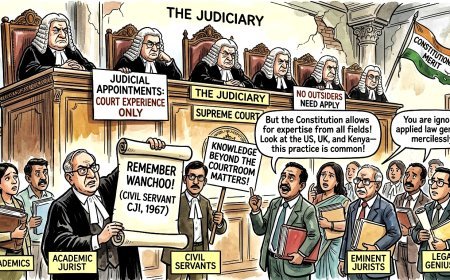
While the Indian Constitution explicitly permits lawmakers to determine their own salaries, it notably omits any mention of retirement benefits. This makes logical sense: a five-year term of public service should not automatically entitle someone to a lifetime of substantial allowances. Unfortunately, today’s political class exploits this ambiguity to sanction exorbitant post-service benefits for themselves. The higher judiciary, which could take suo motu cognizance of this issue, often looks the other way, fueling the perception of a compromised system. Given the intense public outrage over these hefty, per-term pensions, the courts should halt these benefits until a transparent law is enacted. Ultimately, it may take a massive, Gen Z-style youth agitation to hold both political opportunists and the judicial establishment accountable.
What's Your Reaction?