



























The Forgotten Clause: How India’s Judicial Monopoly Defies the Constitution

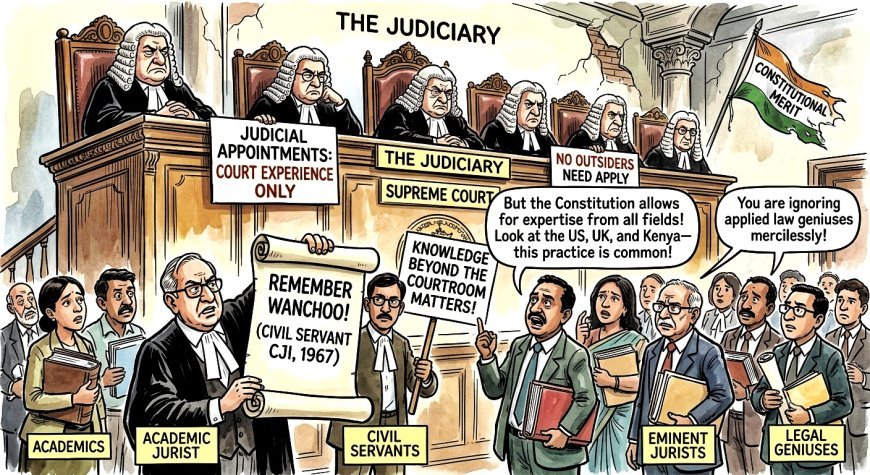
For 76 years, a revolutionary provision of the Indian Constitution has gathered dust, actively ignored by the very institutions sworn to uphold it. Article 124(3) explicitly allows the President to appoint a ‘distinguished jurist’ to the Supreme Court. Yet, in over seven decades, not a single legal scholar, academic, or jurist has been elevated to the highest bench.
By systematically ignoring this constitutional mandate, the Executive and the Judiciary have built a closed ecosystem, shutting out brilliant minds possessing the visionary wisdom needed to shape the nation’s legal destiny.
The 76-Year Blind Spot: Justice Bhuyan’s Wake-Up Call
Recently, Supreme Court judge Justice Ujjal Bhuyan tore into this complacency. Speaking at a university convocation, he delivered a fiery critique of this institutional failure. He rightly emphasised that the Supreme Court is not merely an adjudicatory body, it is the ost respected ‘moral, legal, and constitutional conscience keeper’ of the country.
Core Takeaways from Justice Bhuyan’s Critique:
A Wasted Mandate: The failure to utilise Article 124(3) is a regrettable constitutional defiance.
Need for Diversity of Thought: A constitutional court requires profound theoretical frameworks, not just judges who have climbed the traditional career ladder.
An Insult to Academia: The continued refusal to appoint scholars suggests a flawed belief that India’s world-class law universities lack talent worthy of the Supreme Court.
Global Standards vs. The Indian Echo Chamber
Across the world, leading democracies actively recognise that the mechanics of trial law are not the only ways to understand justice. India’s refusal to appoint academics is a stark anomaly on the global stage:
The United States: Many of the most influential Supreme Court Justices- including Ruth Bader Ginsburg, Antonin Scalia, Stephen Breyer, and Felix Frankfurter-brought extensive academic and teaching backgrounds to the bench.
The UK, Canada & Kenya: These jurisdictions routinely elevate brilliant legal scholars to their constitutional courts, seeking out fresh perspectives and out-of-the-box thinkers.
Shattering the ‘Practical Experience’ Myth
The primary defence for excluding jurists in India is their alleged lack of ‘practical experience’ in courtrooms. Justice Bhuyan slammed this argument as ‘very shallow’, and the facts support his stance.
When the Supreme Court grapples with profound questions of fundamental rights, constitutional morality, and the fabric of democracy, visionary wisdom, deep scholarship, truly sharp analytical skills matter infinitely more than a mastery of trial court procedural technicalities.
The Magnificent Precedent: A Chief Justice Without a Law Degree
For those who argue that traditional legal experience is the only path to the top, history provides a stunning reality check. Exceptional administrative acumen and problem-solving skills have always existed outside traditional courtrooms.
Consider Justice Kailas Nath Wanchoo, who served the nation as the 10th Chief Justice of India between 1967 and 1968. His tenure holds a highly unique place in Indian legal history: he never possessed a formal law degree.
Instead of traditional legal education, his foundations were built on criminal law taught during his Indian Civil Service training in the UK. His remarkable ascent proves that brilliance and capability are not confined to practicing advocates:
1926: Began his career as an Assistant Magistrate and Collector in the United Provinces.
1937: Promoted to Sessions and District Judge.
1947: Appointed as a judge at the Allahabad High Court.
1951: Elevated to Chief Justice of the Rajasthan High Court to remain in place for the longest period of seven years..
1958: Appointed as a Judge of the Supreme Court of India.
1967: Sworn in as the 10th Chief Justice of India on the 12th April until retirement on 24th February, 1968 setting an all-time record.
If an ICS officer with no formal law degree could successfully lead the highest court in the land, the system’s refusal to open its doors to distinguished jurists today is indefensible.
Time for Accountability: Breaking the Monopoly
The blame for this ongoing constitutional defiance falls squarely on two entities:
The Executive: For decades before the 1990s, the Centre held absolute power to appoint judges but never once found an Indian academic ‘distinguished’ enough for the role.
The Collegium: Since taking over appointments, the Supreme Court Collegium has operated as an opaque fraternity. By exclusively picking from the ranks of High Court judges and senior advocates, they have turned Article 124(3) into a dead letter.
It is by now known that the Collegium and the government have ignored truly brilliant candidates for a few key reasons which are illogical and grossly misconceived :
The Collegium heavily favors seasoned High Court judges and practicing senior advocates. The prevailing administrative mindset is that managing the Supreme Court’s crushing, complex docket requires gritty courtroom experience and procedural knowledge, not just theoretical or academic brilliance.
Institutional Inertia: The current pipeline of elevating judges from lower courts or the Bar is a well-established, standardized machine. Tapping into academia would require the Collegium to define new, highly subjective metrics for what constitutes a “distinguished” jurist—a debate the system has historically avoided.
Perceptions of Legal Academia: As Justice Bhuyan noted, decision-makers might perceive that Indian legal academia lacks the necessary “depth” to be seriously considered for the highest court, or perhaps neither the government nor the Collegium has ever genuinely tried to explore this constitutional avenue.
Ultimately, the failure to appoint exceptional academic jurists stems from a rigid judicial culture that equates capability almost entirely with traditional litigation and bench experience.
The Constitution was not drafted to create a monopoly for career judges and practising lawyers; it was thoughtfully designed to ensure that the wisest, most capable minds safeguard our democracy.
The Collegium and the government must actively begin identifying distinguished jurists for the highest court. We need judges who don’t just read the law, but who have spent their lives understanding its philosophy, its flaws, and its vast potential. Until the doors of the Supreme Court are opened to the scholars and thinkers the Constitution explicitly made room for, India’s judicial system will remain fundamentally incomplete.
What's Your Reaction?