



















The Weaponised ‘Form 6’ and Why Gyanesh Kumar still Survives the ECI Crisis


The Election Commission of India, once globally revered as a fortress of democratic integrity, is currently engulfed in what may be the most severe institutional crisis in its history. At the centre of this storm stands Chief Election Commissioner (CEC) Gyanesh Kumar. Despite facing an avalanche of public pressure, widespread protests, and unprecedented internal leaks, Kumar appears largely unmoved. For critics, political watchdogs, and civil society, the reason for this apparent impunity is glaringly obvious: the unwavering political shield provided by the Modi-Shah administration.
To understand the sheer gravity of this constitutional crisis, one must look beyond the political rhetoric and examine the structural vulnerabilities, legal blind spots, and institutional silence that are currently defining the ECI.
The 'SIR’, Form 6, and the Supreme Court’s Blindspot
For the ordinary citizen, understanding the Special Intensive Revision (SIR) and ‘Form 6’ is critical to understanding how elections can be manipulated before a single ballot is cast.
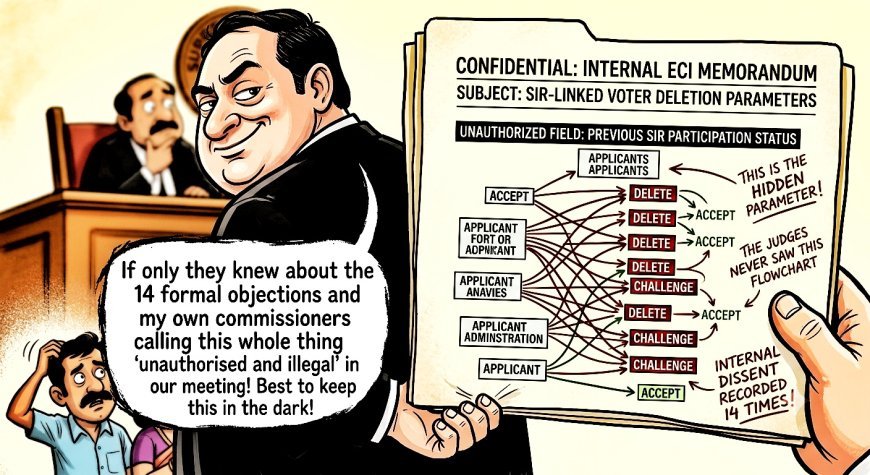
Simply put, the SIR is an exercise meant to update and clean up electoral rolls. ‘Form 6’ is the standard application used by citizens to register as new voters. The big controversy erupted when it was discovered that a new, unauthorised parameter was added to the ‘Form 6’ portal on the ECI's network. New applicants were suddenly being asked whether their name, or the names of their parents or grandparents, had appeared in a previous SIR exercise.
This simple issue matters the most. By linking new voter registrations to previous SIR data without statutory authorisation, the ECI fundamentally altered the voter enrollment process, creating a mechanism that critics argue could be weaponised for mass disenfranchisement or deletion of targeted voters.
This issue was challenged in the Supreme Court, which ultimately ruled the SIR move as lawful. However, legal experts, opposition leaders, and democratic watchdogs argue that the Court passed a fundamentally flawed order because it was not given a clear, unvarnished explanation of the technical manipulation of Form 6. Had the judiciary been fully briefed on how Form 6 was covertly altered- rendering the changes ‘unauthorised and illegal’, as described internally by one of the ECI's own commissioners- legal consensus suggests the Court would have dismissed the SIR initiative entirely. Instead, an opaque technicality slipped through the cracks of justice.
An Autocratic CEC and the Illusion of Unanimity
The crisis of the ECI is not just about rogue software; it is about human vulnerability and institutional design. Recently, a blockbuster exposé by The Indian Express shattered the ECI’s facade of unity. The investigation revealed that the two other Election Commissioners, Sukhbir Singh Sandhu and Vivek Joshi, had formally recorded objections at least 14 times over a 10-month period. These objections directly challenged Gyanesh Kumar’s unilateral decisions regarding voter registration, the deletion of names, and the handling of the electoral-roll data.
Yet, publicly, these two commissioners have maintained a bizarre silence, even issuing statements suggesting unanimity within the Commission. To the public, this makes them appear spineless. However, the reality of their vulnerability is baked into the Constitution itself.
Under Article 324(5) of the Indian Constitution, the CEC enjoys the same security of tenure as a Supreme Court judge and can only be removed through a lengthy, cumbersome parliamentary impeachment process. The other two Election Commissioners, however, do not share this immunity; they can be removed by the President simply on the recommendation of the CEC. This creates a terrifying power imbalance. The two commissioners cannot afford to publicly displease the boss, as they possess no legal shield against internal aggression from the CEC. They are trapped in a system where survival requires compliance, rendering their internal dissent toothless in the face of an autocratic chief.
For his detractors, Gyanesh Kumar has been exposed as heavily partisan- a puppet installed to execute the electoral will of the Modi administration. Despite the documented internal pushback against his methods, he remains shielded by the very government that benefits from his management of the electoral rolls.
The Judicial Shadow: Justice Satish Chandra Sharma
The controversy has also spilled over into the highest court of the land, pulling Supreme Court Justice Satish Chandra Sharma into the murky picture. Justice Sharma has been involved in hearing challenges related to the laws governing the ECI and its commissioners.
However, a glaring conflict of interest has been raised by independent legal observers: Justice Sharma’s son serves as the standing counsel for the Election Commission of India before the Madhya Pradesh High Court. While this does not legally prove actual bias, it raises severe questions of judicial propriety. When a judge is ruling on matters directly affecting the integrity of the ECI while a direct family member is on the institution's payroll, the optics severely damage the credibility of the judicial process. For critics, this undisclosed layer of influence further explains why the Supreme Court failed to aggressively interrogate the ECI's machinations regarding ‘Form 6’ and the SIR.
The Strange Silence of the Mainstream Media
As this unprecedented democratic crisis unfolds, a glaring question remains: why is the mainstream media largely silent?
Aside from exceptional investigative work by agencies like ‘The Indian Express’, the broader television and print media landscape has either downplayed the ECI’s internal warfare or ignored it altogether. The reasons are rooted in political economy. A vast majority of India’s mainstream media is owned by corporate conglomerates with deep ties to the ruling establishment. Furthermore, the government exercises immense leverage through the distribution of state advertising revenues and the looming threat of central investigative agencies like the ED and CBI. For many media houses, aggressively pursuing a story that questions the very legitimacy of the Modi-Shah electoral machinery is a risk that invites immediate financial and administrative reprisal. Consequently, the task of informing the public has fallen to independent digital portals, civil society organisations, and social media activists.
Establishment evidently Rattled
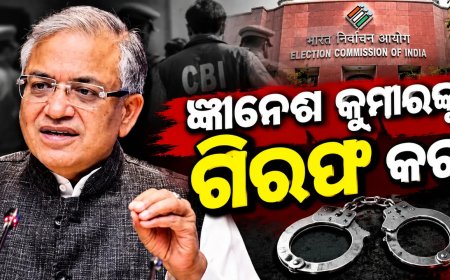
Frontline civil rights organisations, including the ‘Citizens for Justice and Peace’ and various political coalitions, have essentially declared a procedural war against Gyanesh Kumar, demanding his immediate arrest and impeachment. The public outcry is immense, with demands that elections conducted under his leadership be annulled and subjected to rigorous public scrutiny.
Because of the rebellious stance and shrill outcry of the public against the ECI, the Modi-Shah duo is badly rattled. The unfolding drama suggests they have lost steam and venom. The rushed ECI press note on September 26- which attempted to project normalcy but was widely panned as an inadvertent ‘admission of guilt’ regarding ECI mismanagement- signals deep institutional anxiety. The frantic effort by the administration to choke opposition voices and cage the rebel commissioners reveals that it is certainly terrified of the truth that is not being popularly discussed across the society.
The BJP’s electoral hegemony relies heavily on the perception of an invincible, flawlessly managed democratic process. The undeniable documentary evidence of the internal ECI rebellion, combined with growing public awareness of voter-roll manipulation has wholly shattered that perception already. The Modi-Shah administration may hold the levers of power, but the exposure of Gyanesh Kumar has forced them into a defensive posture, fighting to conceal the fractures in their political machinery.
Ultimately, the crisis surrounding Gyanesh Kumar is not merely a bureaucratic dispute over voter software. It is a battle for the foundational integrity of the Indian republic. When the referee of the world's largest democracy is widely perceived to be playing for one side, and the institutions designed to check his power are structurally compromised, the very survival of the electoral mandate is at stake.
What's Your Reaction?