


























INSIDE THE EMPTY CORRIDORS OF STATE-LEVEL AIIMS : GRAVEYARDS OF HOPE



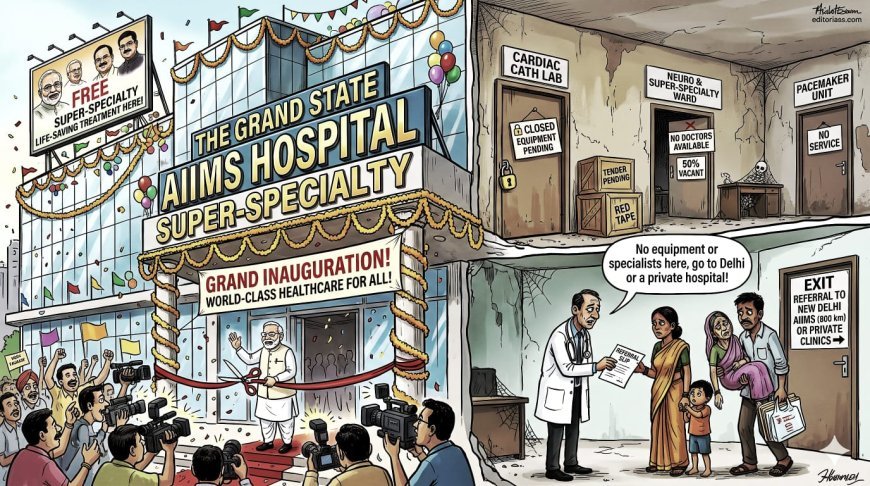

Nothing exposes a systemic deceit more starkly than what recently transpired at the All India Institute of Medical Sciences in Gorakhpur. Built with an outlay exceeding one thousand crore rupees, its outpatient department was launched in 2019 and the full hospital complex inaugurated in December 2021. Yet, nearly five years after its grand launch, when on 30 October, 2026, the institute’s own Executive Director, a retired Major General Dr Vibha Dutta, suffered sudden cardiac complications on campus, she was naturally rushed to the emergency ward of her own hospital. Her condition demanded an immediate cardiac evaluation and possible pacemaker intervention- a routine procedure performed every single day in modest district hospitals across the country. But what followed showed that the entire planning system was a gross failure. The treating doctors could not perform the intervention because the hospital did not possess an operational Cardiac Catheterisation Laboratory. The chief executive of an apex central institute had to be bundled into an ambulance and transported to a local private hospital for specialised evaluation.
The administration hastily scrambled to issue damage-control statements, claiming that seventy per cent of the procurement was complete and the facility would function within a few months. But the damage had already been done. The veil had slipped completely. If the administrative head of a premier central government hospital cannot get basic interventional cardiac care within her own premises, what hope remains for the landless farmer or the daily-wage labourer who travels hundreds of kilometres from the rural hinterlands of eastern Uttar Pradesh or northern Bihar, can be easily assessed even by an ordinary school student.
The inauguration ceremony of any state-level AIIMS outfit is invariably spectacular and breathtakingly so. Ribbons are cut. Speeches thunder through the neighbourhood. Politicians stand before gleaming glass and spotless marble, loudly promising a revolution in public health.
Across the length and breadth of India, sprawling medical campuses branded as institutes of national eminence have been unveiled before cheering crowds in the past few years. For millions of poor, underprivileged families, these magnificent buildings represent salvation, the solemn promise that they will never again have to mortgage their ancestral land, sell their cattle, or plead with village moneylenders just to purchase a few days of life in a private nursing home.
Yet, step past the polished glass entrance and into the emergency corridors, and the illusion shatters into cruel pieces. Behind the imposing facades lie hollow shells. The grand national promise of accessible super-specialty medicine has quietly deteriorated into an exercise in political vanity, where concrete triumphs over compassionate care, and ordinary referral centres masquerade as apex medical temples.
The trajectory of this public deception follows a painfully familiar pattern. First comes the grand announcement, followed by the laying of foundation stones amidst widespread fanfare. Soon, hundreds of crores of public money are poured into towering glass and concrete structures. Then comes the hasty ribbon-cutting, timed carefully to suit political calendars long before life-saving diagnostic machinery has even arrived at the loading dock. What the public ultimately inherits is a structure stripped of its essence: missing lifelines such as ‘Cath labs’, ‘Linear accelerators’, and ‘Trauma blood banks’, alongside dozens of empty departmental chairs and a revolving-door policy that turns desperate patients right back into the street.
The tragedy is that a hospital is neither its brick, nor its mortar, nor its manicured lawns. A hospital is defined entirely by its doctors, its nurses, its surgeons, and its diagnostic equipment. Across the vast network of newly established peripheral institutes, this human engine is conspicuously absent.
Official records placed before Parliament tell an alarming story. Across peripheral institutes, faculty vacancy rates consistently hover between thirty-five and forty per cent. In several newer establishments, the deficit is catastrophic. At AIIMS Mangalagiri, more than half of the sanctioned faculty posts lie unoccupied, forcing advanced surgical units to function on a skeleton crew. In AIIMS Madurai, the vacancy rate has climbed beyond seventy per cent, leaving promised multi-specialty care crippled under mountains of red tape. At AIIMS Rajkot, nearly sixty per cent of specialist chairs remain empty, leaving complex cases in the hands of visiting staff or junior residents. Even AIIMS Gorakhpur, nearly five years past its full inauguration, carries around a hundred unfilled faculty posts.
These chairs remain perpetually empty because putting up concrete walls is easy, but building a thriving medical ecosystem requires genuine commitment. Centralised recruitment procedures drag on through endless administrative hurdles. Compensation packages remain uncompetitive when set against the private corporate sector. Worse still, the talented specialists who do join soon find themselves stranded without the instruments they need to practice their craft. A brilliant cardiac surgeon or an experienced neurosurgeon cannot save lives with bare hands in an operating theatre that lacks functional diagnostic tools, reliable monitors, or trained paramedical staff. Disillusioned by administrative indifference, skilled doctors walk away, leaving behind departments that exist solely on paper.
For the wealthy and the powerful, healthcare in India is seamless. If an apex hospital lacks a facility, they are shifted under green corridors to deluxe private suites without missing a heartbeat. But the public healthcare system was never conceived to serve the privileged. It was built as a constitutional lifeline for the widow selling vegetables on the pavement, the rickshaw-puller whose chest is gripped by sudden angina, and the rural family watching their child burn with acute encephalitis.
These poor citizens arrive at the gates of these institutes clutching battered medical files in thin polythene bags. They arrive after spending their last five hundred rupees on bus fares, having placed their entire trust in government advertisements. They genuinely believe that this sparkling, air-conditioned campus will save their loved ones without demanding bribes or catastrophic hospital bills.
Instead, they are met by the cold, unfeeling machinery of institutional helplessness. Routine procedures that should be available at any standard hospital- coronary angiographies, emergency stent placements, dialysis sessions, or radiation therapy- are declared unavailable. The doctor on duty, overworked and under-equipped, scribbles a few hurried lines on a discharge slip: referred to a higher centre due to non-availability of facilities.
That brief scribbled note is often a death sentence. To these families, a ‘higher centre’ means another exhausting journey across states to the suffocatingly overcrowded corridors of AIIMS in New Delhi, hundreds of miles away. Many breathe their last inside rattling, non-air-conditioned state buses on national highways, dying during the precious ‘golden hour’ when their lives could have been saved by a simple machine sitting unpacked inside an administrative warehouse.
Those who cannot undertake the journey to the capital collapse into the predatory arms of private nursing homes operating right outside the hospital gates. These clinics charge exorbitant fees, forcing destitute families to surrender their family gold, sell off tiny plots of farmland, and sink into lifelong generational debt just to settle a medical bill that the state had solemnly promised to shoulder for free.
This is not a failure of Indian medical science; our doctors remain among the most gifted and resilient in the world. It is a failure of statecraft, governance, and basic human empathy. It is the direct consequence of treating public health as an electoral public-relations exercise rather than a sacred constitutional obligation. Foundation stones are laid before land acquisition is clear, ribbons are cut before machines are calibrated, and tenders for essential equipment remain buried under bureaucratic files while leaders boast about expanding the national medical map.
An apex medical institute cannot be judged by the way its glass reflects the afternoon sun, nor by the elegance of its administrative suites. Its true worth is measured solely by what happens in its emergency ward when an ordinary human being arrives on the threshold of life and death. Until these sprawling campuses are staffed with permanent specialists, until every promised ‘Cath lab’, linear accelerator, and trauma unit is fully operational, and until the poorest citizen is afforded the same urgent dignity as a high dignitary, these institutions remain a cruel illusion. Dressing up secondary-level dispensaries in the grand costume of world-class hospitals does not heal the sick; it merely provides a magnificent architectural backdrop against which the poor are abandoned to die.
What's Your Reaction?