

























WHY OUSTING ONE ELECTION COMMISSIONER WON'T SAVE INDIA'S DEMOCRACY


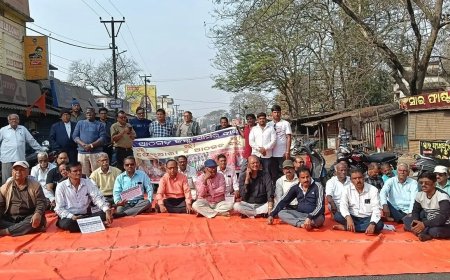
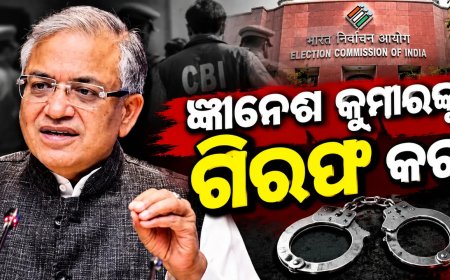
As protests engulf the capital over the Election Commission of India’s Special Intensive Revision exercise, public fury has found a singular target: Chief Election Commissioner Gyanesh Kumar. The allegations are grave- that the ECI is actively weaponising the voter verification process to systematically disenfranchise suspect anti-establishment voters under the guise of purifying electoral rolls. In response, a chorus of political leaders and citizens are demanding the CEC’s immediate resignation.
But this outrage, while righteous, is dangerously misdirected. Attacking or removing a single individual like Gyanesh Kumar is a tactical error that plays directly into the hands of the ruling establishment. It ignores the fatal, underlying disease in favour of treating a symptom. The real threat to India’s democratic fabric is not the man in the chair, but the rigged institutional mechanism that put him there: the ECI selection panel.
The Compromised Selection Panel is the The Original Sin :
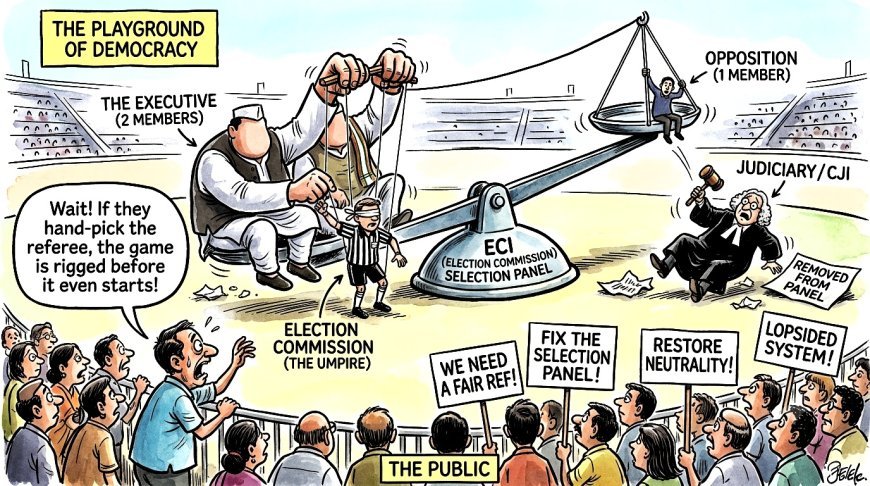
To understand the current crisis, one must look at the legislative manoeuvring that upended India’s democratic balance of power. In a landmark early 2023 ruling, a Supreme Court Constitution Bench mandated that the ECI selection committee must consist of the Prime Minister, the Leader of the Opposition, and the Chief Justice of India to ensure the electoral umpire remained insulated from the executive. But instead of respecting this institutional safeguard, the government brazenly enacted a new law in late 2023, tossing out the CJI and replacing him with a Union Cabinet Minister nominated by the Prime Minister, both from one interested side.
This single legislative stroke institutionalised a 2-1 executive majority. It rendered the LoP a helpless bystander- a mere stone figure forced to watch one-sided, predetermined appointments. Under this lopsided framework, the selection panel ceased to be a neutral arbiter and became an instrument of executive will. If Gyanesh Kumar is forced to step down tomorrow, the machinery will simply install another carefully vetted official in his place. Removing the CEC without changing the panel is akin to replacing a cog in a machine that is inherently designed to favour the ruling party.
Judicial Complicity and the Roster Management Crisis
The executive’s audacious power grab could not have succeeded without the passive accommodation of the Supreme Court. The highest court in the land is now facing intense scrutiny for failing to decisively strike down this constitutional subversion. When the 2023 ECI appointment law was challenged, the legal battle became mired in delays, culminating in the deeply controversial events of September 2026. A two-judge bench comprising Justice Dipankar Datta and Justice Satish Chandra Sharma heard the challenges. On September 23, the bench delivered a split verdict, with Justice Sharma referring the matter to a larger Constitution Bench. This referral effectively deferred any immediate judicial intervention, allowing the ECI to continue operating under the shadow of a disputed ‘appointment law’.
The controversy surrounding this judicial delay was compounded by glaring allegations of conflict of interest. Transparency activists and legal bodies raised alarms that Justice Sharma was adjudicating the very legitimacy of the ECI while his son allegedly served as a legal counsel for the poll body. Instead of prioritising the unassailable integrity of the court, the matter proceeded, resulting in a verdict that conveniently bought the executive more time.
The Medha Roopam Saga: Shattering the Optics of Impartiality
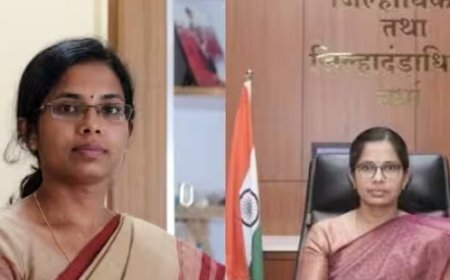
If the split verdict raised eyebrows, the Supreme Court’s handling of the Medha Roopam case completely shattered public faith in institutional impartiality. Medha Roopam, the District Magistrate of Noida, is the daughter of the defamed CEC Gyanesh Kumar. Earlier in the year, she arbitrarily invoked the draconian National Security Act to detain Akriti Chaudhary, a 24-year-old Delhi University law student participating in a workers’ protest. No young girl student has ever suffered an NSA charge ever in independent India.
Fortunately, on September 2, the Allahabad High Court struck down this blatant abuse of power. The High Court quashed the detention, delivered scathing strictures against Roopam for acting despotically and ‘without applying due mind,’ and ordered a hefty 5 lakh-rupee penalty to be recovered directly from Roopam’s salary. She flew away to the Supreme Court seeking instant relief. What followed in the Supreme Court has been perceived by many as a masterclass in institutional privilege. Roopam’s appeal bypassed the usual queues, being listed ‘out of turn,’ and landed before a bench headed by none other than Justice Satish Chandra Sharma even though he was not part of the designated bench. On September 23, the exact same day as the ECI split verdict- the bench swiftly granted her interim relief. While leaving the quashing of the NSA detention intact, the court quietly froze the High Court’s strictures and the Rs.5 lakh financial penalty.
That very vourt outcome was devastating. The daughter of the CEC received expedited relief from a judge whose own conflict-of-interest allegations regarding the ECI were making national headlines. Furthermore, lawyers noted that the video-conferencing facility fell mute throughout the hearing, with no explanation provided for the lack of transparency. This sequence of events sent a chilling message to the public: the executive, the electoral machinery, and segments of the judiciary are seemingly operating as a mutually protective ecosystem.
The Weaponisation of the SIR is now part of heated public discourse occurring across India. This structural decay directly enables the weaponisation of administrative exercises like the Special Intensive Revision. When the electoral rolls are managed by an ECI born of a compromised selection panel and shielded by a hesitant judiciary, every administrative action becomes legally and morally suspect. The ECI’s fundamental mandate is to facilitate voting and maximize democratic participation. Yet, under the current framework, the SIR is widely viewed not as a purification of the voter list, but as a surgical tool deployed to discard dissenting demographics.
The Path Forward: Target the Structure, not the enslaved functionary.
The agitators, the opposition, and civil society must pivot their crosshairs. Demanding the resignation of one Election Commissioner is a distraction that wastes precious political momentum. Gyanesh Kumar is merely a product of a flawed system.
The battle must be fought to dismantle the 2-1 executive-dominated ECI selection panel. The administration must be pressured to accept a truly neutral collegiate system, reinstating the CJI, or empowering the CJI to nominate an eminent, unbiased citizen to the third seat.
Simultaneously, the Supreme Court must be held to its own constitutional duty. The apex court cannot allow controversial roster management, muted hearings, and delayed judgments to erode public faith in the rule of law. The nation’s democratic fabric is unravelling not because of just one controversial man in the ‘Nirvachan Sadan’, but because the foundational checks and balances have been systematically dismantled. Until the selection panel is rectified to ensure true neutrality, the promise of free and fair elections will remain entirely out of reach. The CJP qnd its followers have to wake up to the glaring fact that unless ତ୍ୟେ selection panel is made truly neutral, Gyanesh Kumar after Gyanesh Kumar will keep materialising in succession.
For the agitating public, the current political climate presents an unprecedented window of opportunity. The momentum of the ongoing protests, driven heavily by youth and civic groups like the CJP, is no longer just a reaction to the Election Commission; it is a direct, visceral backlash against the judiciary’s own rhetoric.
The Supreme Court’s moral authority in the public eye was severely compromised in May 2026 when the Chief Justice of India Surya Kant controversially remarked that some unemployed youth were becoming ‘parasites’ and ‘cockroaches’ who turn into social media or RTI activists. Instead of silencing dissent, those words acted as a profound catalyst. By alienating the very demographic facing the brunt of unemployment, the highest office of the judiciary unwittingly galvanised a unified, unapologetic ‘protest community’.
This history has left the institutional establishment visibly uneasy whenever the CJP and allied youth groups mobilise publicly. The agitators know that the CJI and the courts are now dealing with the fallout of a movement they inadvertently helped turbocharge. The public onslaught from these groups has grown so intense that the internal political pressures faced by the Modi-Shah administration arguably pale in comparison.
The establishment finds itself cornered not merely by political opposition, but by a sprawling, energised youth movement demanding systemic accountability from every pillar of the state. For the citizens agitating on the streets, the timing has never been more favourable: the institutional cracks are visible, the establishment is on the defensive, and the demand to dismantle the rigged ECI selection panel is finally taking centre stage.
What's Your Reaction?