
























DEFENDING INSTITUTIONAL INDEPENDENCE AGAINST EXECUTIVE OVERREACH


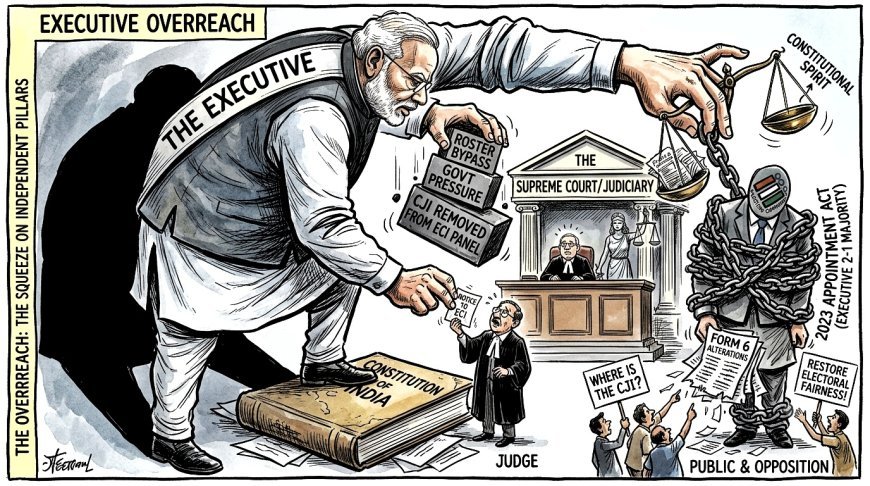
To understand the true spirit of a Constitution, young educated people must look beyond the black letter in the books and examine the mechanics of power. A Constitution is not merely a rulebook outlining how a government operates; it is primarily a defensive mechanism. Its fundamental purpose is to limit the power of the state, ensuring that those who hold temporary political mandates cannot permanently alter the rules of the game to remain in power indefinitely. History repeatedly demonstrates that political executives, driven by the desire to consolidate authority and prolong their tenure, often attempt to weaken the checks and balances designed to restrain them. They rarely do this through overt suspension of the Constitution. Instead, they cause democratic decay usually through the subtle, legalised capture of independent statutory and constitutional bodies, and the gradual softening of judicial resistance.
In the Indian context, the separation of powers and the absolute independence of the Election Commission of India and the Supreme Court, are non-negotiable for the survival of the great republic. When these institutions are perceived to be compromised, or when the judiciary is accused of becoming overly deferential to the executive, the very bedrock of democratic culture stands threatened. For the sensitively educated young people of India, analysing how authority can be manipulated to hollow out these institutions is essential to understanding the fragility of democracy.
The Design for Electoral Capture
The most potent weapon in a democracy is the vote, and the custodian of that weapon is the Election Commission. Article 324 of the Indian Constitution vests the superintendence, direction, and control of elections in the ECI. For this mandate to be meaningful, the Commission must be structurally insulated from the political executive. If the government has unchecked power to appoint the umpires, the fairness of the electoral match gets instantly compromised.
For decades, the appointment of Election Commissioners was an executive prerogative, a historical anomaly that the Supreme Court attempted to rectify. Recognising the inherent danger of allowing the executive sole discretion over electoral referees, a Constitution Bench mandated a neutral selection committee comprising the Prime Minister, the Leader of the Opposition, and the Chief Justice of India. This was a highly laudable judicial recognition of the constitutional spirit primarily because the need to balance power and prevent majoritarian dominance over democratic infrastructure was urgent.
However, the constitutional safeguards are only as strong as the political will to uphold them. The Modi administration subsequently utilised its parliamentary majority to pass the Chief Election Commissioner and other Election Commissioners Act, 2023 for the sole critical purpose of appointing, setting conditions of service, and determining the term of office. This legislation, purposefully removed the Chief Justice of India from the selection panel, replacing the judiciary boss of the country with obviously an enslaved Union Cabinet Minister nominated by the Prime Minister.
From a constitutional law perspective, this was a masterful, although deeply controversial, exercise of legislative power to subvert a judicial safeguard. By creating a 2-1 executive majority on the selection panel, the provision legally ensured that the ruling government could push through its preferred candidates, reducing the leader of the opposition to a meek spectator. When this law was challenged, critics argued that the Supreme Court’s reluctance to take immediate suo motu cognizance or stay the legislation signalled a troubling judicial deference. The failure to aggressively defend the institutional balance it had just attempted to create left the ECI horrifically vulnerable to complete executive capture.
The consequences of this structural compromise are not merely theoretical; they manifest in severe operational crises that directly impact the citizenry. The recent nationwide uproar over the manipulation of ‘Form 6’ serves as a glaring case study for law students on how institutional capture translates into the potential disenfranchisement of voters.
Form 6 is the statutory application for inclusion in the electoral register. During a recent ‘Special Intensive Revision’ of electoral rolls, an unauthorised declaration was introduced alongside Form 6, allegedly requiring new voters to map their ancestry back to a 2002 base roll. Civil rights groups and political opposition outfits immediately identified this as a sophisticated tool for demographic profiling and targeted voter suppression.
What makes the Form 6 controversy particularly alarming for constitutional scholars is the revelation of internal collapse within the ECI. Reports indicate that the two Election Commissioners formally objected multiple times to unilateral decisions being made by the Chief Election Commissioner without their consensus. When a multi-member constitutional body designed to operate on consensus is allegedly overridden by a single executive-favoured appointee, the institutional design fails entirely. It took immense public pressure and a barrage of Public Interest Litigations to force the Supreme Court to wake up and take action. While the Chief Justice Surya Kant was forced to issue notices to the ECI, sharply clarifying that the apex court had never approved any modifications to Form 6, the episode exposed how deeply vulnerable the electoral machinery had become to alleged political engineering.
Judicial Independence and the ‘Master of the Roster’
If the Election Commission is the referee of the democratic process, the judiciary is the ultimate guardian of the constitutional spirit. Yet, the judiciary itself is not immune to the gravitational pull of a powerful executive. For young crusaders, understanding judicial independence requires analysing not just how judges rule, but how courts are administered.
A central point of critique in contemporary Indian constitutional law is the administrative authority of the Chief Justice as the ‘Master of the Roster’. The CJI holds the exclusive power to constitute benches and allocate cases. While this is an administrative necessity, it becomes a constitutional vulnerability if utilised to shield the executive from scrutiny. Critics, including former judges and senior advocates, have long raised alarms that politically sensitive cases- those possessing the potential to embarrass or check the power of the ruling establishment- are frequently bypassed from certain independent-minded judges and assigned to benches perceived as more deferential.
This roster manipulation, whether real or perceived, strikes at the heart of judicial credibility. When the public and the legal fraternity begin to predict the outcome of a constitutional challenge based solely on the bench assignment, the authority of the Supreme Court is severely diminished. It fosters an environment where the judiciary risks being viewed not as an independent pillar, but as a facilitator of the executive will.
Furthermore, the legal community frequently debates the concept of ‘judicial evasion’- the practice of the court endlessly delaying hearings on critical constitutional matters, such as electoral bonds, the abrogation of Article 370, or the ECI appointment act, until the executive has achieved its political objectives and the issue becomes a fait accompli- something that has been perfectly established and cannot be changed. When the Supreme Court hesitates to pass hard-hitting orders against a government with a formidable parliamentary majority, it inevitably invites allegations that the judicial leadership is operating out of fear of political retribution. The Constitution envisions a judiciary that acts as a fearless counterweight to majoritarian excess; a judiciary filled with voices that prioritise executive convenience over democratic values betrays that foundational vision.
The Burden of the Next Generation
The intersection of the Form 6 controversy, the restructuring of the ECI, and the debates surrounding judicial allocation paints a complex picture of India’s constitutional health. It illustrates how an executive can utilise the very mechanisms of democracy- parliamentary majorities and administrative procedures- to subtly dismantle the checks and balances designed to contain them.
For young people keen to understand the basics of law, the lesson is stark: the Constitution is not a self-executing document. It does not defend itself. It relies entirely on the courage, integrity, and vigilance of the individuals who fill its institutions as key functionaries. When the political executive is relentless in its pursuit of power, and when constitutional bodies are allegedly coerced into submission, the burden of upholding the democratic culture falls heavily on the legal fraternity and the citizenry.
Studying the spirit of the Constitution means recognising that legalism- simple adherence to the letter of the law while violating its intent is a more recent method of subverting the democratic culture. Passing a law to exclude the Chief Justice from selecting electoral umpires may be procedurally legal under parliamentary rules, but it is deeply hostile to the constitutional spirit of fairness.
As young ones prepare to enter the legal profession, they must understand that defending democracy requires more than memorising statutes. It requires the courage to identify and challenge the abuse of authority, to question the administrative machinations of the courts, and to demand absolute transparency from all statutory bodies. The Supreme Court’s recent intervention in the Form 6 crisis demonstrates that the judiciary still possesses the critical capacity to correct the course, but such interventions must be the norm rather than the exception triggered only when a massive public outcry turns deafening. The future of the republic depends on a legal ecosystem that refuses to become ‘yes creatures’ to power, which ensures that the Constitution remains a living shield against the eternal political ambition for absolute control over every domain that keeps democracy truly vibrant.
What's Your Reaction?