











The Deputy Delusion: Political Appeasement Over Constitutional Sanctity

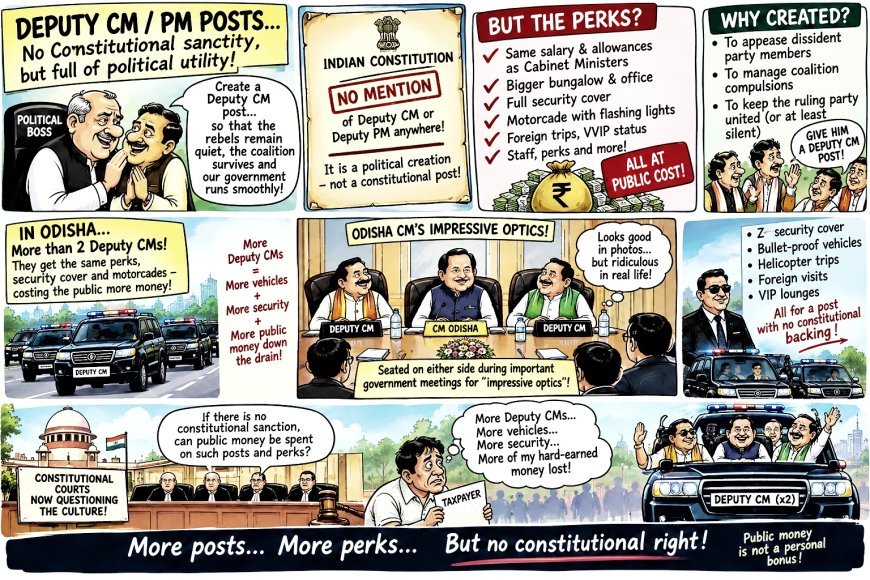
Indian politics is uniquely peculiar in character and it has no parallel anywhere in the world. It has long mastered the art of inventing grandeur for false optics mainly to deceive headless fellow political creatures as well as the gullible masses. Among the most glaring examples of this political theatre is the post of the ‘Deputy Chief Minister’ and its national equivalent, the ‘Deputy Prime Minister.’ It is a designation entirely devoid of constitutional sanctity, serving not as an administrative necessity, but as a cheap, convenient tool to pacify disgruntled factions, appease difficult lawmakers, and hold fragile coalition governments together.
Nowhere in the Constitution of India will you find the job description of a Deputy Chief Minister. The Supreme Court of India, when confronted with the legality of the post, has unfortunately not taken the issue to its logical conclusion by declaring the provision outright illegal. Instead, the apex court has merely stripped the title of its imagined legal superiority, clarifying that a Deputy CM’s legal stature is equal only to that of a standard Cabinet Minister. Their perks, entitlements, and oaths of office are fixed accordingly. They do not possess overriding vetoes, nor do they constitutionally command other ministers.
Yet, the illusion persists. Most Deputy CMs swagger through the corridors of power harbouring the delusion that they are strictly second-in-command, positioned a notch below the Chief Minister and a mile above the rest of the cabinet. The gullible public, influenced by grand media optics and political posturing, buys into this fabricated hierarchy.
The recent regime change in Odisha serves as a perfect, tragicomic case study of this constitutional farce. Chief Minister Mohan Majhi, evidently operating under the strict directives of his central bosses in Delhi, was flanked by two Deputy CMs upon taking the oath. The move was clearly engineered to balance caste, regional, and gender equations rather than to streamline governance.
One of these deputies is Prabhati Parida, a first-time MLA whose sudden elevation has left political observers baffled. To say she is struggling with her portfolio would be a generous understatement. Critics and assembly watchers note an evident blankness in her approach to governance; she exhibits a glaring lack of basic parliamentary conduct and an inability to confidently face critical questions on the floor of the House. Even with magnificent, top-tier bureaucratic support attempting to prop her up, the cracks in her competence are highly visible.
Her tenure as Tourism Minister has already courted massive controversy. In a baffling display of misplaced priorities, the tourism department blew a staggering Rs 2.32 crore on an ill-conceived ‘Pakhala Day’- an event that hasn’t even been formally accepted or institutionalised. This colossal waste of public funds on a manufactured extravaganza has resulted in both the Deputy CM and the Chief Minister being mercilessly roasted across social media platforms, with the outrage continuing to simmer today.
But incompetence is only half the allegation. Political opponents are increasingly vocal with accusations of corruption, alleging that she is in an unseemly hurry to amass wealth and consolidate power. More damaging to her political capital is her treatment of former BJD rebel Samir Dash. It is an open secret in her constituency that without Dash’s crucial groundwork and support, Parida would never have tasted electoral victory. Yet, upon ascending to the deputy’s chair, she has merrily sidelined him. This betrayal has left a sour taste, turning the local electorate against her and sparking grassroots resistance that threatens her political longevity.
On the other side of this make-believe hierarchy sits the second Deputy CM, Kanak Vardhan Singdeo. Unlike Parida, Singdeo is a seasoned, highly experienced political heavyweight. Yet, his performance has been equally disappointing. Despite his vast administrative exposure, he is underperforming, drifting through his tenure for reasons best known to the party high command. His wealth of experience is inexplicably not translating into actionable governance, leaving him as little more than a prestigious placeholder.
Ultimately, the grand design of this arrangement reveals itself in the daily media optics. In almost every press briefing and photo opportunity, Chief Minister Mohan Majhi ensures he is flanked by these two make-believe deputies. They serve as his political bumpers- absorbing the factional friction of the party and acting as human shields against public scrutiny, keeping the Chief Minister out of direct danger.
However, there have been allegations recently that Odisha’s two Deputy Chief Ministers Kanak Vardhan Singh Deo and Pravati Parida are claiming larger motorcades, higher security, and invariably seating on either side of the Chief Minister ‘as equals’, which raise legitimate questions of protocol, public expenditure, and constitutional propriety.
It must be made clear that between 1990 and 2024, the Supreme Court has repeatedly held that a Deputy Chief Minister is only a Cabinet Minister with a politically glamorous title which confers no higher constitutional rank, no extra powers, and no automatic entitlement to superior protocol, security, or facilities beyond what a regular Cabinet Minister receives.
Any enhanced facilities must therefore be justified by specific security threat assessment or explicit government orders passed with valid logic, not by the mere use of the title ‘Deputy Chief Minister.’
A freshly filed PIL is pending before a Division Bench of the Orissa High Court. The petitioner has specifically alleged that the two Deputy CMs are being given heightened protocol and status that robs the public of big money. The two cabinet ministers in the garb of ‘Deputy chief minister’ are stealing enhanced security and facilities.
The petitioner has argued that huge public money is being spent on these superficially painted functionaries- one of them a pinhead and the other having lost administrative skills to a great extent. Thus the Court will have to rule on the exact issue of ‘extra perks and protocol.’
People must know that the size of motorcade and level of security are decided by the State Security Committee or the Home Department on the basis of threat perception only, never the meaningless title.
If the facilities truly exceed those of other Cabinet Ministers without a documented security justification, it is improper and open to judicial scrutiny. The pending PIL is the correct forum to take the final call on this disturbing issues. The enraged public has to be assured that Justice prevails in India. Larger motorcades and extra security personnel, if not backed by threat assessment, can be struck down as arbitrary expenditure of public money.
All the same, it is high time the electorate and the judiciary take a harder look at the ‘Deputy’ phenomenon. It is a constitutional fiction that drains the exchequer to fund inflated egos and VIP cavalcades, offering zero administrative value in return. Governance requires capable ministers, not superficial titles handed out as political participation trophies. Chief Minister Majhi has to display absolute command over his subordinate colleagues seeking more privileges than due. Or else, the masses will continue to look down upon him as a helpless puppet.
What's Your Reaction?