
















The Prince of a Poor State: A Betrayal of Democratic Mandate and Tribal Simplicity

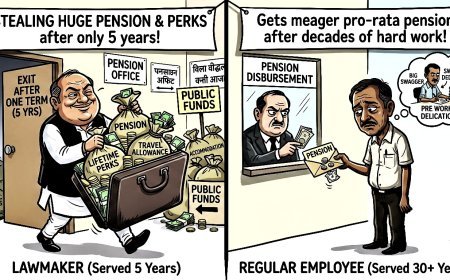
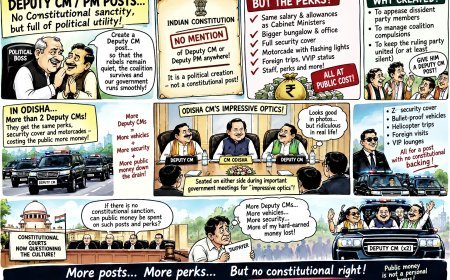
The most recent revelation that the Odisha government spent over Rs. 3.31 crore to repair and renovate two official residences for Chief Minister Mohan Charan Majhi has rightfully struck a nerve with the public. But the rot of unchecked privilege runs far deeper than fresh paint and expensive furnishings. In Odisha that continues to grapple with pressing developmental challenges, the Chief Executive Officer of the state is treating the public exchequer as a personal treasury, rapidly assimilating into a lifestyle that resembles a reigning monarch rather than a democratic public servant. When the 2024 elections concluded, the winds of change swept a new BJP government into power in Odisha. For many ordinary MLAs and newly minted ministers, victory came as a surprise- a sudden stroke of political luck that handed them the reins of the state. One expected then that leaders who won ‘by chance’ would step into their roles with deep humility and a fierce desire to prove their worth to the common man. Instead, the very first priority for many of these new representatives was to give themselves a royal upgrade using people’s money. They drained the public exchequer to turn residential houses into mini palaces by renovating and furnishing the dwelling outfits extravagantly without worrying for one moment that many disadvantaged people – particularly the service giving tribe in the city lived in deplorable conditions without a roof over the head.
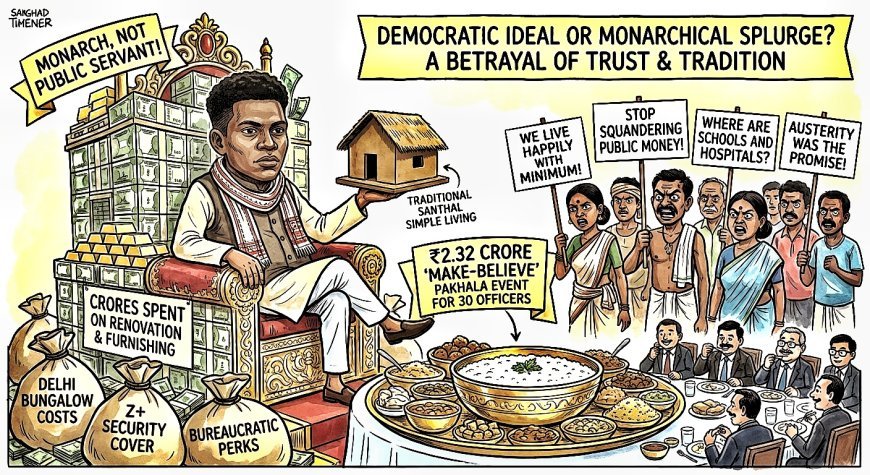
The public outrage today is intensely amplified by a profound sense of cultural betrayal. Chief Minister Majhi hails from the ‘Santhal’ tribe, a community historically celebrated for its deep-rooted simplicity, egalitarianism, and harmonious coexistence with nature. The traditional Santhal way of life is defined by unpretentious, windowless thatched houses and a diet intrinsically tied to the roots and fruits of countless native plants, alongside traditional delicacies like ‘monitor meat’ and ‘ant chutney’. This is a community that embodies the virtue of living happily and meaningfully with minimal resources. For generations, the Santhal community has been respected for showing the world how to live without greed, pomp and glamour.
Majhi’s ascent to the highest office in the state could have been a powerful, historic homage to this heritage. He is in a uniquely powerful position to set a precedent of absolute austerity and become a model of simple living for the entire nation. Instead, he has discarded the virtues of his wonderful community, choosing to live like a prince on the dime of a poor state.
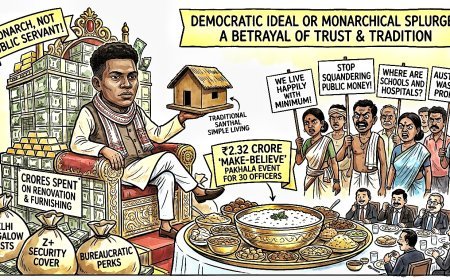
This lavishness is frequently camouflaged by manufactured administrative necessities. Despite having hardly any genuine threat perception, Majhi has shielded himself behind the highest category of security cover. This fortress mentality extends well beyond Bhubaneswar. He has availed a heavily staffed bungalow in New Delhi, maintained at great cost and guarded by an expensive Odisha Police security detail, bleeding state resources for the sake of national capital prestige.
Worse still, this culture of indulgence has infected the bureaucratic machinery under his watch. In a bizarre and indefensible administrative manoeuvre, his ministry had permitted the former serving Chief Secretary to retain a sprawling bungalow in Delhi for his family, by handing the chief bureaucrat of the state the ‘additional charge’ of ‘Chief Resident Commissioner’.
But perhaps nothing exposes the administration’s mockery of the commonman quite like the recent Rs. 2.32 crore squandered on a make-believe ‘Pakhala devouring’ public event. Pakhala- is water rice which is the ultimate symbol of Odia humility, a staple of the hardworking farmer-most so for the ‘Santhal’ community and a beloved ‘summer comfort’ for the masses. To burn over two crores of public money to serve this humble dish to a mere 30-odd ministers and bureaucrats is an astonishing insult to every taxpayer. It was a grotesque spectacle that used the state’s cultural identity as an excuse for financial abuse.
In a functional democracy, the public exchequer is a sacred trust, and an elected representative is bound by duty to serve the masses, not to elevate himself above them. By plundering public money to finance heavily guarded bungalows, elite bureaucratic appeasement, and farcical culinary events, the Chief Minister has brought shame to the state- more so to his magnificently exemplary community. True authority is never derived from the grandeur of an official residence or a bloated security detail; it comes from the moral clarity and integrity of the leader.
In a state where many families still struggle to get basic healthcare, education, and jobs, spending crores of rupees on a politician’s living quarters feels entirely wrong. In a democracy, the money collected from taxpayers belongs to the public. The young citizens are the most enraged lot today. As they appear to have suddenly become frantic to reform society, they must now ask tough questions to ensure a better future. They must raise voices and demand that the leaders live simply and serve honestly as ‘true authority’ does not come from grand houses, bloated security teams, or multi-crore lunches, but from honesty, integrity, and working for the people. They are fully aware that an elected leader is a public servant, not a king. So, when a leader treats the state wealth as a personal slush fund, he ceases to be a public servant and becomes exactly what democracy was designed to dismantle.
What's Your Reaction?