

THE PARADOX OF PROTOCOL: WHEN THE 'PEOPLE'S PRESIDENT' LOSES TOUCH




When in July, 2022, Droupadi Murmu was announced as the candidate for President, the Odia diaspora across the globe erupted in rapturous celebration because her victory would be a natural outcome anyway. An Odia, a woman, and a tribal to boot- an exceptionally rare combination- her nomination filled the community with immense pride. Expectations naturally soared sky-high: hopes abounded that her elevation to the nation’s highest office would use its authority to turn Odisha into a paradise. The revelry was historic.
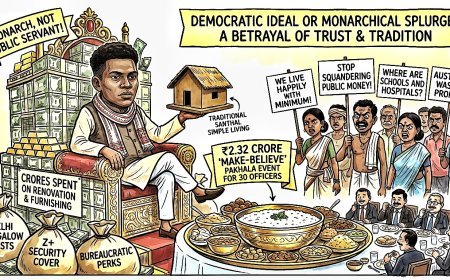
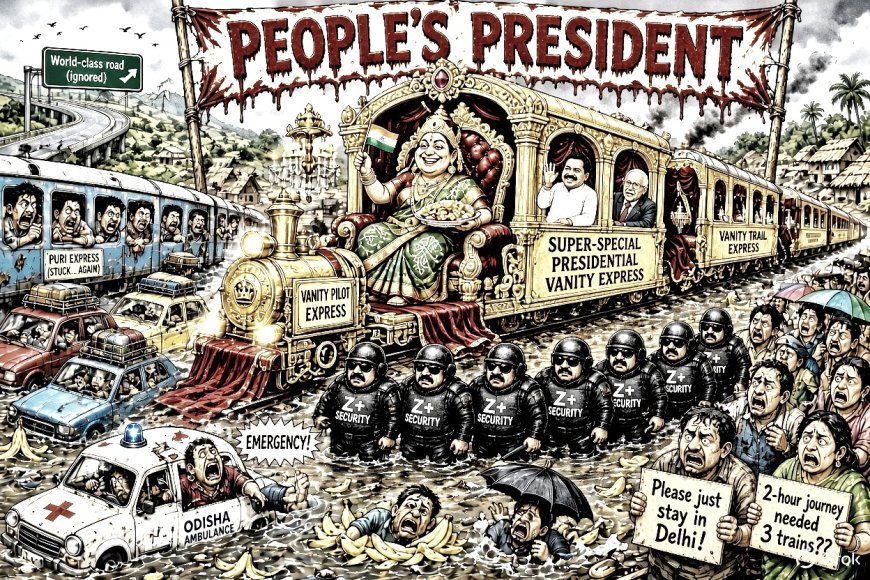
Fast forward to October 2026, and an equally intense wave of emotion swept across the state- only this time, for all the wrong reasons. A collective sigh of relief washed over Odisha when the nation’s first citizen cancelled her visit. By then, her relentless sojourns to her home state had become an administrative ordeal, routinely throwing public life into disarray for no discernible gain. Beyond ostentatious security convoys, luxury trains, and hollow displays of vanity, she had delivered nothing of substance to the people. For an exhausted and disillusioned public, the cancellation was a welcome reprieve- sparing them yet another round of disruptive, callous ceremonialism.
When news emerged that President Droupadi Murmu’s scheduled visit to her home state of Odisha had been cancelled, the overarching sentiment on the streets was not one of disappointment, but of a quiet, collective sigh of relief. For the ordinary citizens of Odisha, the frequent homecomings of the First Citizen have increasingly become synonymous with paralysed traffic, massive security cordons, and an administrative standstill that makes daily life miserable.
This growing resentment brings into sharp focus the widening gulf between the humble, pro-poor origins of the President and the gilded cage of her current office.
It is difficult for the Indian public not to draw comparisons with former President A.P.J. Abdul Kalam. Widely revered as the true ‘People's President’, Kalam actively dismantled the pomp and show of the highest office. He famously insisted on minimal security and refused to let his official visits become a financial or logistical burden on the states he toured. He viewed himself as an ordinary citizen tasked with an extraordinary job. Today, the extravagant VIP culture and heavy residential luxuries accompanying President Murmu’s visits- drawing unwelcome parallels to the heavily criticised tenure of Pratibha Patil- suggest a stark departure from that humility.
But the civic disruption is merely the surface of a much deeper disillusionment. A growing chorus of critics points to a troubling subservience to the Executive. The most glaring instance was the inauguration of the new Parliament building. Despite the President being the constitutional Head of both Houses, she was sidelined, leaving Prime Minister Narendra Modi to take centre stage. The fact that this unprecedented constitutional slight was met with silence from Rashtrapati Bhavan, rather than rightful assertion, painted a picture of a President willing to act as a mere rubber stamp. Furthermore, her tendency to sit on crucial bills until cleared by the Prime Minister’s team reinforces the perception of an office stripped of its independent constitutional authority.
Then there is the complex issue of cultural identity and optics. Elevated to the highest office as a symbol of tribal empowerment, her public persona has increasingly reflected a sanitised, mainstream political narrative. She is frequently seen performing highly publicised rituals at Hindu temples, whilst simultaneously being a member of the ‘Prajapita Brahma Kumaris’- a sect that traditionally eschews idol worship to focus on internal spiritual work. Critics say that she rarely observes the native ‘Santhali’ religious festivals; and she does not seem to have taught the ‘Ol Chiki’ script to her own children. Her participation in a very few Santhali ceremonial events is increasingly viewed by detractors as mere political optics rather than genuine cultural preservation.
in August 2026, the disconnect was glaringly obvious when parts of the state were grappling with devastating floods. Instead of grounded empathy, the President opted for a highly publicised, luxurious train journey from Bhubaneswar to Berhampur. The choice was baffling, considering the two cities are connected by a world-class national highway that takes a mere two hours by car. For many, the extravagant train ride was seen not as a necessity, but as a desire to show off super-luxury to the impoverished people of her home state. The train was brought all the way from Delhi for the highly avoidable 2-hour journey. That super special train was flanked by two additional escort trains- one running in front as a pilot train and another trailing behind in the rear. Key operational and security measures included strict track clearance with no regular traffic and exclusive platform access. The whole route was brought to a standstill to let her train pass. All regular trains were put on halt inconveniencing thousands of passengers, some of them patients heading for emergency healthcare. The brightest brains in the system told publicly that the ‘train mode’ was selected only due to heavy rain forecasts by the IMD.
This perceived apathy extends beyond transport choices to a troubling silence on the abuse of power. In a shocking incident of 2024, the son of Governor Raghubar Das allegedly assaulted a Puri Raj Bhavan security officer simply because super-deluxe vehicles were not organised for his hooligan friends. Adding insult to injury, the local police refused to register an FIR filed by the victim’s wife, leaving a helpless woman fighting for justice against the state machinery. The absolute silence from Rashtrapati Bhavan on this blatant criminal entitlement was deafening. Yet, the Odia President did not publicly express any upset over the shameful event, doing precious little to intervene or ensure justice for the horrifically aggrieved family.
President Murmu began her journey as a grassroots leader, intimately aware of the struggles of the common man. However, the current trajectory of her presidency suggests a leader who has allowed the trappings of power and the dictates of the Executive to overshadow the voice of the people. Until there is a return to the simplicity and independence the office demands, the cancellation of her VIP visits will continue to be welcomed as a reprieve, rather than mourned as a missed opportunity.
Ultimately, the people of Odisha are now keenly seeking to know how actually the Odia community, or the marginalised tribal population she represents, have gained tangibly from her presidency as they have failed miserably to find anything noteworthy she has done for the people of Odisha.
What's Your Reaction?