























Stateless with a Passport , AADHAR and Voter I-card: The Great Indian Citizenship Hoax

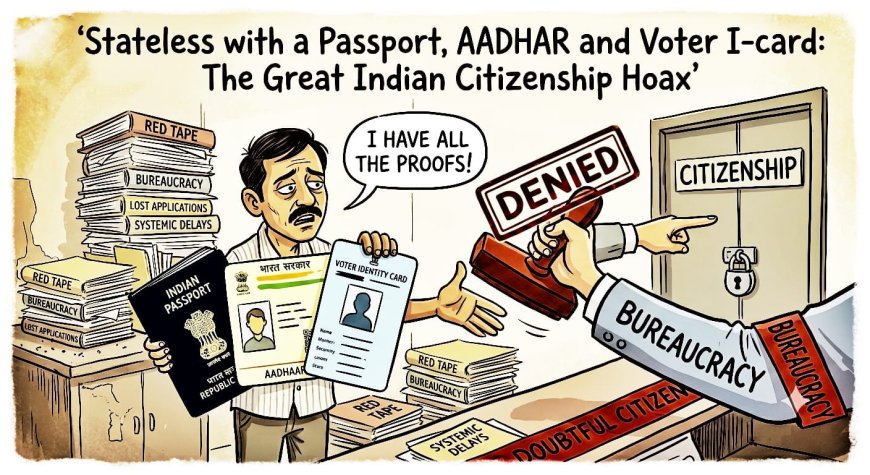
The bureaucratic maze of proving one's identity in India has culminated in a legally fascinating, yet deeply unsettling, paradox that strikes at the very heart of what it means to belong to a nation. An ordinary Indian today can possess a government-issued permanent account number to pay their taxes, a heavily encrypted biometric ID to receive their daily rations, an elector’s photo identity card to choose their leaders, and a gold-embossed stamped booklet to travel the globe. Yet, if you stack all these formidable documents together on a magistrate's desk, legally speaking, you might just be a heavily documented resident, not necessarily a citizen of India. Recent clarifications from the Ministry of External Affairs and unequivocal rulings by the Supreme Court of India have laid bare a startling, chilling fact: the most rigorous, hard-to-obtain documents in the country do not actually prove you are an Indian. This deliberate legal loophole has triggered widespread anxiety, quiet political outrage, and a fundamental constitutional question. If the passport and the ‘Aadhaar’ do not make an Indian a citizen, people are frantic to know what exactly does, and more importantly, who benefits from this terrifying ambiguity.
For decades, the Indian passport was universally revered as the ultimate, unassailable proof of identity. Obtaining one requires a highly complex, intricate, and confusing process of document submission, biometric capture, and a physical police verification right at your doorstep, carrying an aura of absolute state sanction. However, the Ministry of External Affairs recently sparked a nationwide panic by reiterating a stark legal reality that a passport is merely a travel document, not conclusive proof of citizenship. Legally, the government is completely correct, leaning on Section 20 of the Passports Act of 1967, which grants the state discretionary power to issue passports or travel documents to non-citizens in specific ‘public interest’ scenarios. Because this obscure provision exists, the passport itself cannot serve as an airtight guarantee of nationality. It merely proves that the government allows you to travel under its temporary protection, but it does not definitively prove you belong to the soil. This creates an absurd legal nightmare where a document born from the most rigorous state vetting, cannot establish domestic citizenship, leaving the ordinary, law-abiding person in a state of perpetual documentation anxiety.
If the passport is legally insufficient, one might naturally look to the Aadhaar card, the most ubiquitous piece of identification in modern India, holding the biometric data of over a billion people. Yet, the Supreme Court of India, the Unique Identification Authority of India, and various state registration departments have repeatedly and emphatically shattered this illusion. Aadhaar is strictly proof of identity and residence. It proves nothing more than the fact that a specific human being with specific fingerprints and irises lives at a specific address within the country's borders. It does not confer, nor does it prove, citizenship. The voter ID proves one is on an electoral roll, and the PAN card tracks one’s financial footprint, but neither can stand up in a tribunal as absolute proof of Indian nationality.
When the state declares that standard IDs like Aadhaar, voter IDs, and passports cannot prove citizenship, it isn’t just a legal quirk- it is a sinister political weapon. This manufactured ambiguity exposes the ruthless machinations of the BJP super strategists. By keeping citizenship criteria deliberately fluid, the state grants local bureaucrats the arbitrary power to strike legitimate voters off electoral rolls. Millions face the sudden, terrifying threat of disenfranchisement.
This is not a system failure; it is a meticulously designed feature to eliminate demographics likely to vote against the BJP. By forcing the marginalised and poor into a desperate scramble for ancestral paperwork, the ruling establishment creates an environment of intimidation, ensuring they remain too busy fighting for their existence to organise politically.
Adding logically amusing hypocrisy to this grim reality is Prime Minister Narendra Modi. While ordinary natives sweat to assemble decades of fragile documents just to prove they belong, the PM remains terrified of showing his own educational degrees. His marital status has magically fluctuated across election affidavits without triggering any state inquisition. The irony is spectacular: the government demands flawless historical documentation from its most vulnerable, while shielding the highest office from basic scrutiny.
So, if every piece of plastic and stamped booklet in one’s wallet is legally inadequate, no native can easily prove that he or she is an Indian. The truth lies buried in the Citizenship Act of 1955, which states that citizenship is acquired by birth, descent, registration, or naturalisation. Because India refuses to issue a single, universal certificate of citizenship to people born within its borders, proving one’s nationality relies entirely on a complex, fragile chain of historical evidence. For most, it requires proving not just their own date and place of birth, but often the precise citizenship status of their parents and grandparents. This means relying on birth certificates, ancestral land records, and historical family registers from decades past. In a country where millions were born at home without any formal hospital registration, where catastrophic floods routinely wipe out entire villages, and where administrative record-keeping has historically been an afterthought, demanding a flawless paper trail of ancestry is a monumental, impossible cruelty.
The current legal and political architecture leaves the Indian populace in a terrifyingly precarious position. When a government states that its own rigorously verified documents are not enough to prove nationality, it inadvertently, or perhaps intentionally, turns its entire citizenry into perpetual suspects.
The BJP-controlled NDA administration has successfully weaponised paperwork. While the legal distinction between a travel document and citizenship proof makes perfect sense in the sterile halls of the Supreme Court, it translates to pure panic on the ground for the common man. The ultimate goal of remaining in power for decades is served perfectly by this chaos.
So, until the government establishes a clear, accessible, and singular proof of citizenship, the people of India will continue to live in a logically amusing, yet deeply disturbing, paradox. They are citizens everywhere in daily practice, but legally, thanks to the wicked designs of their rulers, they are always just one missing piece of paper away from being nobody at all.
What's Your Reaction?