


























HOW JUDGE JITENDRA SINGH RESTORED THE SOUL OF THE JUDICIARY

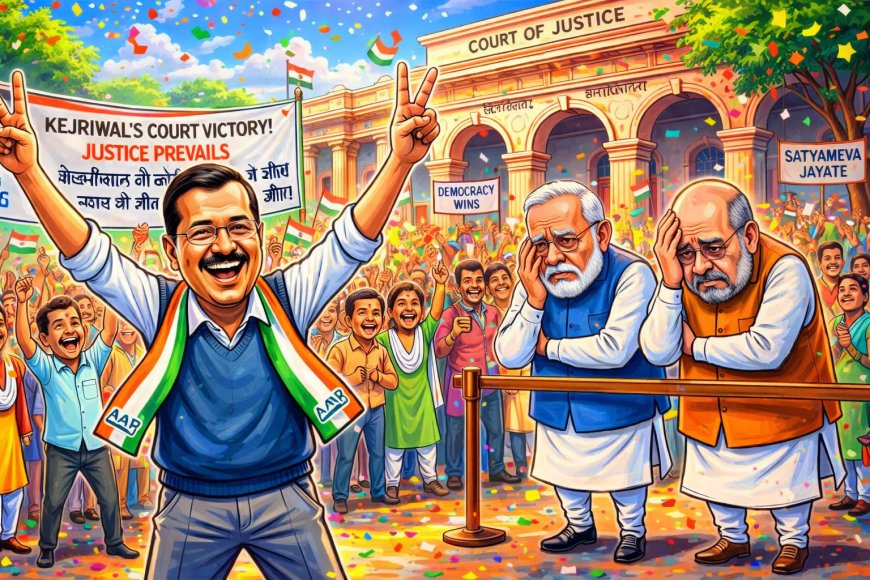
‘February 27, 2026’, will be remembered as the day the ‘Caged Parrot’ lost its dignity and sting. The judgment delivered by Special Judge Jitendra Singh of the Rouse Avenue Court is not merely a legal document; it is a scathing manifesto against the ‘weaponisation’ of the criminal justice system in India. By discharging former Delhi CM Arvind Kejriwal, Manish Sisodia, and 21 others in the Delhi Excise Policy case, Judge Singh performed a forensic autopsy on a prosecution built on sand. Judge Singh’s ruling reveals a chilling reality: the ‘Delhi Excise policy’ gun was never loaded, and the smoke was only a theatrical illusion. Judge Singh is now hailed as a rare ‘Hero’.
At the heart of Judge Singh’s ‘hero’ narrative is his refusal to be seduced by labels. For quite some time the CBI and ED kept tossing around the term ‘Hyderabad Group’ in most of the televised press briefings and charge sheets as a synonym for a shadowy criminal conspiracy. Singh’s judgment demolished this nomenclature as a legal fiction, noting that the CBI relied on ‘conjecture and surmises’ rather than admissible evidence.
As the primary role of the judiciary is to distinguish between a policy failure and a criminal conspiracy, Judge Singh delved deep into the matter and came to know the truth. So, he hit the nail on the head: a policy decision, even one that was eventually withdrawn, cannot be criminalised without the presence of a clear quid pro quo. By pointing out the total absence of a verified money trail, the court reminded the executive that in a democracy, it cannot jail a politician simply because it disagrees with its cabinet’s arithmetic.
Perhaps the most ‘hard-hitting’ aspect of the ruling was the demolition of the prosecution’s star witnesses. The Indian legal system has long struggled with the ethics of the ‘approver’- the accomplice who trades testimony for a pardon. Incidentally, one Magunta Sreenivasulu Reddy, a liquor baron and MP from Andhra Pradesh and another P. Sarath Chandra Reddy, a pharma company owner were the central figures that had eventually provided the testimonies the Enforcement Directorate (ED) and CBI used to arrest Arvind Kejriwal and others. Initially, both these wicked men were accused by the agencies of being part of the ‘South Group’ that organised bribes for the AAP. Around then, these two had screamed ’No Bribe to any’. However, their roles shifted when Magunta’s son Raghav was picked and put behind bars for five months, and Sarath Reddy was arrested by the ED on charges of money laundering. Suddenly one fine morning both Raghav and Sarath turned approvers (witnesses for the state). Magunta, though accused and charge sheeted by both the agencies, was never arrested. Judge Singh’s analysis of these two suspect characters was a masterclass in judicial scepticism. He highlighted a suspicious, rhythmic pattern:
· The witnesses had initially stated they had no knowledge of bribes.
· They were arrested and denied bail for months.
· Under the crushing weight of jail, they suddenly ‘remembered’ the alleged bribes.
· Raghav and Sarath were granted a pardon and immediate bail after implicating BJP’s political rivals.
Singh rightly labelled these statements as ‘tainted.’ When the ‘process becomes the punishment,’ and the state offers freedom only in exchange for a scripted confession, it is no longer a search for truth- it is a ‘hostage negotiation’. By rejecting these coerced testimonies, the Judge upheld Section 114(b) of the Evidence Act, asserting that an accomplice is unworthy of credit unless corroborated by hard, material facts. In this case, there were no chats, no emails, and no bank transfers- only the unverified whispers of no-integrity men desperate to go home. Judge Singh found the chargesheet filed by the CBI not only legally deficient, but also fabrications akin to a ‘stupid fairy tale’. Consequently, he ruled that the charges leveled against the AAP leaders were both false and politically motivated, declaring that no charges could be framed on the basis of these ‘make-believe’ documents. In his verdict, he announced that the entire case was discharged, as it was deemed entirely unfit for trial.
The whole episode reveals the big ‘crisis of credibility’ for the Executive. The fallout of the historic judgment extends far beyond the courtroom; it lands directly at the doorstep of the Prime Minister and the Home Minister.
The use of the Prevention of Money Laundering Act (PMLA) to ensure prolonged pre-trial incarceration has become a hallmark of the current era. By discharging the accused at the prima facie stage, Judge Singh has sent a thunderous message: The court will not be a silent spectator to the normalisation of injustice.
Judge Jitendra Singh’s history of independence is noteworthy- from releasing Amanatullah Khan to upholding summons against BJP leaders- proves that his February 27 ruling was not an act of political leaning, but an act of constitutional adherence.
The ‘Hero of Rouse Avenue’ has set a high bar for the future. He has signalled to the CBI and the ED that the era of ‘trial by media’ and ‘conviction by coerced statement’ is over. If the state wishes to deprive a citizen of his liberty, it must bring a paper trail, not a ‘fairy tale’.
Judge Singh’s 598-page verdict serves as a reminder that the law is the bedrock of any civilised society where facts remain stubborn to keep citizens shielded from the overwhelming might of a vengeful state. This is a resuscitation of the ‘rule of law’ itself.
The fallout of Judge Singh’s ruling acts as a double-edged sword for the Indian establishment. Legally, it serves as a procedural firewall. By insisting that PMLA and the Prevention of Corruption Act cannot be used as ‘substitutes for election-law remedies,’ the court has essentially put the CBI and ED on notice: the era of ‘investigative vacuum’ is over. This precedent will likely be the first line of defence in every pending political money-laundering case, shifting the burden back to the state to prove a ‘standalone criminal offence’ rather than mere ‘election-funding irregularities.’
Politically, the ‘clean chit’ has weaponised Arvind Kejriwal’s return. By framing his absence as a ‘self-imposed exile’ necessitated by a manufactured crisis, the AAP is already pivoting toward a ‘Moral Referendum’ for the next Delhi election. Kejriwal’s dare to the Prime Minister to hold fresh polls- under the shadow of a judicial order that called the probe a ‘choreographed exercise’- leaves the ruling party in a defensive crouch. If the 2025 election was won on the optics of a ‘tainted’ leadership, the 2026 political landscape will be defined by the counter-narrative of a ‘vindicated’ one.
Rare Judge Jitendra Singh’s most courageous ruling will be cited for all times to come as a definitive boundary between administrative discretion and criminal conspiracy. Judge Singh is undoubtedly a hero beyond compare!
What's Your Reaction?