






















Apex Court’s Double Standards: Urgent for Some, Tardy for Others

A frighteningly debilitating chill runs down the spine of a democracy when its most vigilant, watchful and alert guardian- the Supreme Court- tells a citizen that their fundamental rights can wait until the next opportunity shows up.
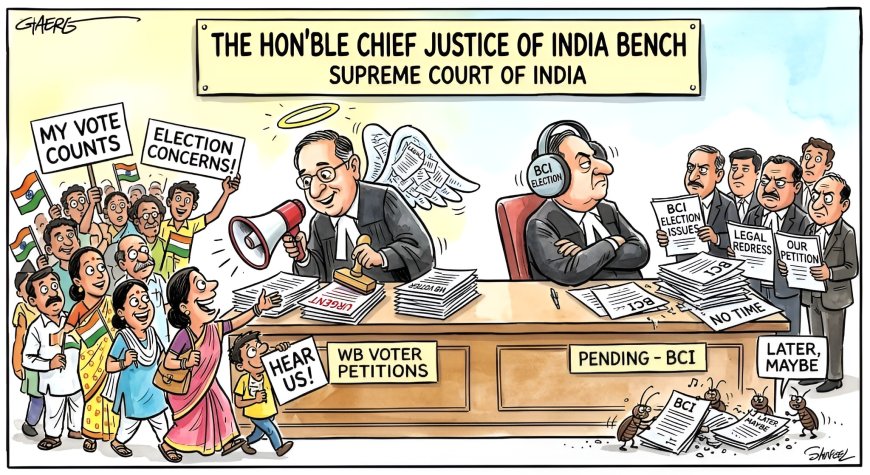
In the grand halls of the Supreme Court, time behaves differently depending on who is standing at the podium. If one is the Bar Council of India (BCI), the clock moves at the speed of light. But if a common citizen from West Bengal fighting for his constitutional right to exist in a democracy, stands in front of the judges, the clock stops until the next five years.
Recent proceedings concerning the systemic disenfranchisement and distress of petitioners in West Bengal have reached a nadir of judicial apathy. When a bench headed by CJI Suryakant and Justice Joymala Bagchi suggests that citizens, currently stripped of their basic rights and facing administrative collapse, should patiently ‘wait and cast their vote in 2031’, it isn't just a postponement of a hearing; it is a fundamental betrayal of the social contract.
For the judges sitting in the consecrated, climate-controlled halls of the apex court, ‘2031’ is a neat chronological milestone. But for a voter in West Bengal whose name has been scrubbed from the rolls, or a petitioner facing state-sponsored intimidation, 2031 is of course an eternity of silence. The court's logic of ‘waiting patiently for 5 years’ suggests that democracy is a seasonal event rather than a continuous pulse. Evidently Justices Suryakant and Bagchi are effectively indicating :
- Petitioner’s current suffering is irrelevant: The immediate violation of rights is treated as a minor procedural hiccup.
- The status quo is protected: Delay is the greatest weapon of an oppressive administration. Every day the court refuses to intervene is a day the ‘law of the jungle’ is validated.
- Justice is a luxury of time: If a common man must wait six years for the restoration of a basic right like voting, the right itself has ceased to exist.
The most galling aspect of this ‘2031 advice’ is the glaring inconsistency in judicial urgency. People have seen the apex court convene at midnight for high-profile convicts, and open its doors on holidays to address the grievances of the elite. Yet, when thousands of common citizens cry out about a breakdown of constitutional machinery in a state, the clock suddenly slows down.
No one knows why the ‘basic structure’ of the Constitution is only invoked so passionately in academic debates, but ignored when the actual foundation- the voter is seeking relief. This double standard suggests a judiciary that is increasingly detached from the disturbing realities of the ‘masses’ it claims to protect.
To tell a petitioner to wait until 2030 is to ignore the ‘mobocracy’ and administrative failures that have already been documented by the court's own observations. When judicial officers themselves are gheraoed and attacked, and the state machinery remains a mute spectator, suggesting a 2030 solution is akin to telling a man in a burning building to wait for the monsoon.
In this case, justice delayed is justice liquidated because by the time 2030 rolls around:
· The political landscape will have been permanently altered by the absence of these voices.
· The perpetrators of current irregularities will have enjoyed the fruits of their actions for years.
· The common man’s faith in the judiciary-the last vestige of hope-will have completely evaporated.
The masses must realise that this isn't just about West Bengal; it’s about a dangerous precedent. If a bench can casually dismiss the immediate needs of one state's electorate, nothing can stop them from causing this harm to many others countrywide.
The masses do not need judges who view constitutional crises through the lens of future calendars; they need a judiciary that understands that ‘now’ is the only thing justice should matter. The guardians of the law have lost public trust and respect by offering a stupid promise for 2030. They have resorted to an abdication.
Nearly around the same time, the bench headed by CJI Surya Kant showed incredible ‘judicial activism’ regarding the Bar Council of India. Whether it was the specifics of the All India Bar Exam (AIBE), enrollment fees, or the internal administrative ego-clashes of the BCI, the Court acted like a fire department rushing to a 5-star hotel. The Irony is that these were merely administrative issues. Nobody’s life was at stake. No one was being silenced by a state machinery. Yet, the Court chose to give the matter hours of precious judicial time. In contrast, the cry of the West Bengal petitioners who claimed their names were illegally scrubbed from the voter lists, which is a ‘civil death’ in a democracy, were sent back home. This ‘Double Standard’ should Alarm the masses. The Supreme Court is the ‘ultimate protector’. But the CJI Surya Kant- headed bench has disappointed the whole nation. He has mastered the lesson in Selective Urgency. Ordinary citizens don’t matter to him. The Bench took the acceptable plea that judicial intervention would ‘disrupt the process’. It had also told the West Bengal petitioners that such issues should be handled exclusively by tribunals rather than the apex court.
The citizens of India do not pay taxes for a judiciary that tells them to ‘wait for 5 years’ while it spends weeks debating the internal rules of a lawyers' club. This is the ‘Double Standard’ that would keep the common man poor, silent, and powerless for always. The Supreme Court has buried the immediate rights of the gullible Indian voter.
What's Your Reaction?