










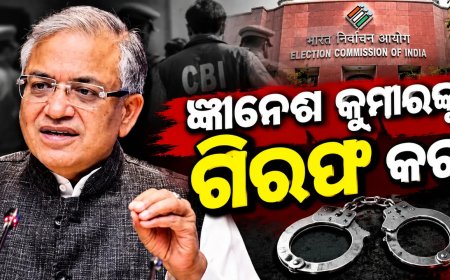
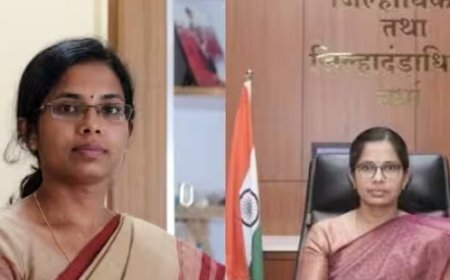












WHEN BUREAUCRATS FORGET THE CONSTITUTION

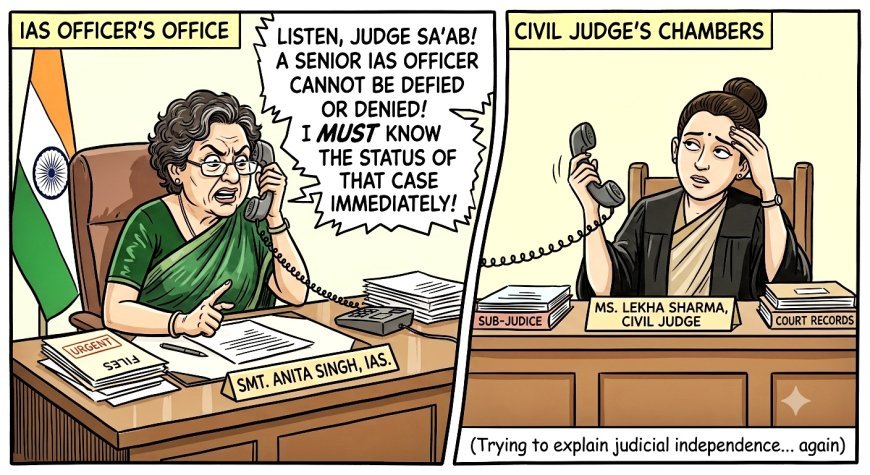
The recent Durga Shakti Nagpal episode is a warning that India’s administrative elite needs discipline, humility and a serious lesson in constitutional governance.
The same Nagpal was once widely portrayed as a courageous and ‘heroic’ IAS officer, particularly after her 2013 campaign against illegal sand mining in Uttar Pradesh. She had become nationally famous while serving as a young officer in Gautam Buddha Nagar. Her administration took action against illegal sand-mining operations, including seizures of vehicles and arrests. She also had faced threats in connection with the crackdown. Strangely, she was also suspended by the Uttar Pradesh government in July 2013 for demolishing of a wall at an under-construction mosque, which became a national controversy which led to widespread public and bureaucratic support for her, and the suspension was eventually revoked.
Now Ms Nagpal is back in the news again– and for the wrong reasons. There is something deeply disturbing about the reported confrontation between Nagpal and Gonda Civil Judge Shabina Khan. The episode is not merely an altercation between two government functionaries; it raises a much larger and more uncomfortable question. It appears as if some members of India’s administrative establishment have begun to forget who exercises what authority under the Constitution.
According to reports, Judge Shabina Khan complained that Nagpal, then Divisional Commissioner of Devi Patan, contacted her by telephone concerning a case pending before her court. The Allahabad High Court’s Lucknow Bench has taken cognisance of the matter and the officer’s conduct has come under scrutiny. Nagpal has denied that she improperly pressured the judge and has offered her own explanation for the call. Although the allegations must be tested through due process rather than be converted into a verdict against the officer, the underlying constitutional principle is beyond dispute : An administrative officer of the state cannot dictate to, intimidate, influence or interfere with the judicial determination of a matter pending before a court. That principle is fundamental to the rule of law because the IAS is not a superior constitutional species.
The extraordinarily glamorous prestige attached to the IAS can sometimes create an unhealthy culture of bureaucratic entitlement. An IAS officer may be a senior administrator, but that does not make him or her superior to the judiciary or above the law.
The Constitution does not create an administrative monarchy. The bureaucracy is the permanent administrative instrument of the elected executive. Its duty is twofold:
· to faithfully implement lawful decisions of the Council of Ministers and, equally importantly,
· to advise that executive on the Constitution, the law and the limits of governmental power.
No bureaucrat possesses sovereign authority. Administrative power is only ‘delegated power’ exercised within the Constitution and under the elected executive. Thus a bureaucrat who mistakes ‘delegated administrative authority’ for independent political power has forgotten the very foundation of parliamentary government.
A District Magistrate, Divisional Commissioner, Secretary or Chief Secretary exercises authority under law and subject to law. Similarly, a judicial officer exercises judicial power within the constitutional and statutory framework. Their jurisdictions may intersect administratively, but no administrator can assume superiority over the other merely because of rank, seniority, designation or political proximity. Most importantly, a judicial order cannot be treated as an inconvenient suggestion even by the topmost member of the political executive.
If an administrator believes a judicial order is erroneous, the remedy is an appeal, review or other lawful proceeding. The remedy is not defiance, obstruction or an attempt to influence the judge. That distinction should be tattooed into the institutional memory of every civil servant.
The Nagpal controversy should become a constitutional teaching moment
The composure reportedly displayed by the civil judge is particularly important. Judges are expected to remain detached from executive pressure, political influence and public emotion. If the reported sequence is ultimately established, the appropriate response is not a bureaucratic counterattack but institutional accountability. And if any officer has actually attempted to interfere with the administration of justice, the consequences cannot depend upon the officer’s rank. That is precisely why allegations of this nature must be investigated independently and fairly.
There should be no double standard: if an ordinary citizen is severely punished for obstructing justice, an exalted bureaucrat cannot receive institutional protection merely because of his or her designation.
Depending upon the facts established, conduct amounting to interference with judicial proceedings may attract serious legal consequences. But that determination belongs to the competent authorities and courts- not certainly to newspaper columns.
America provides an extraordinary lesson
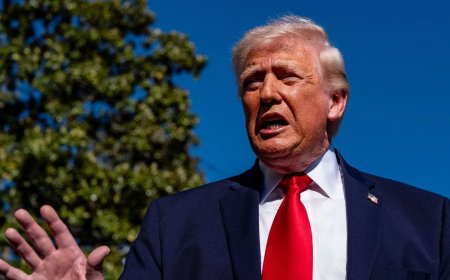
The United States offers an instructive demonstration of the proposition that even the most powerful executive is not above judicial scrutiny. Donald Trump is perhaps the world’s most conspicuous example.
American courts have repeatedly scrutinised, restricted or rejected actions of the Trump administration. Most recently, on August 28, 2026, U.S. District Judge Alvin Hellerstein rejected Trump’s attempt to move his New York hush-money criminal case into the federal court, holding that the conduct concerned Trump’s private affairs rather than protected presidential duties. His 2024 conviction on 34 felony counts therefore remains in place while his appeals continue. The U.S. Supreme Court has also recently refused to revive Trump’s challenge to a 5-million dollar judgment in the E. Jean Carroll case, leaving that judgment final. And in June 2026, the Supreme Court struck down Trump’s earlier attempt to restrict birthright citizenship, holding that the executive order violated the Fourteenth Amendment of the Constitution.
There have also been judicial battles over Trump’s executive order concerning mail-in voting. Even when the Supreme Court later lifted one injunction on procedural grounds, the litigation continued and other judicial restrictions remained in force.
The lesson is not that American courts always defeat Trump. They do not. The lesson is far more important
The President of the United States may be the most powerful elected official in the country, yet he must still answer to law and courts.
If the world’s most powerful political office can be subjected to judicial scrutiny, an Indian bureaucrat certainly cannot regard a judicial officer as someone to be lectured, pressured or overruled.
LBSNAA needs to examine what it is producing
The Lal Bahadur Shastri National Academy of Administration is India’s premier institution for training civil servants. Ironically, its own curriculum provides approximately 400 teaching hours during Phase I of IAS training to cover law, the Constitution, political concepts, public administration and other critical subjects. Yet, a few officers appear to walk out of the Academy leaving much of this learning behind within its hallowed campus. Once posted to the field, these half-cooked bureaucrats become more interested in throwing their administrative weight around, flaunting their authority and keeping their egos permanently inflated than in remembering the constitutional limits of the office they occupy. They are sent out to serve the people, not to rule over them. The real test of an IAS officer is therefore not how much authority he or she can command, but how responsibly that authority is exercised with constitutional restraint, humility and respect for every institution and citizen. Knowing Articles, doctrines and administrative procedures is not enough. An officer must understand the philosophy behind them.
The Constitutional courts have expressed concern about deficiencies in administrative-law understanding among officers and directed attention to proper administrative-law training.
LBSNAA therefore needs more than routine lectures on the Constitution. It needs a cultural overhaul. Trainee officers should be repeatedly taught that power is a public trust, not a personal entitlement. They should be thoroughly exposed to landmark judgments on judicial review, natural justice, contempt, separation of powers and constitutional accountability. They should also learn that disagreeing with a judge is perfectly legitimate; attempting to browbeat the judge is not. Most importantly, they must be taught humility.
The bureaucracy must serve the Constitution, not itself. India desperately needs strong administrators. What India does not need are administrators who mistake authority for personal power. The Nagpal episode, whatever its final legal outcome, should therefore be treated as a warning bell.
An IAS officer enjoys power because the Constitution gives the office lawful authority- not because the officer occupies an exalted place in society. And whenever an administrator forgets that distinction, the courts must be strong enough to remind him or her.
That is not judicial supremacy. That is constitutional supremacy.
What's Your Reaction?