












AMIT SHAH: THE PRIME MINISTER’S CHOSEN SHIELD IS NOW A CRUSHING WEIGHT!


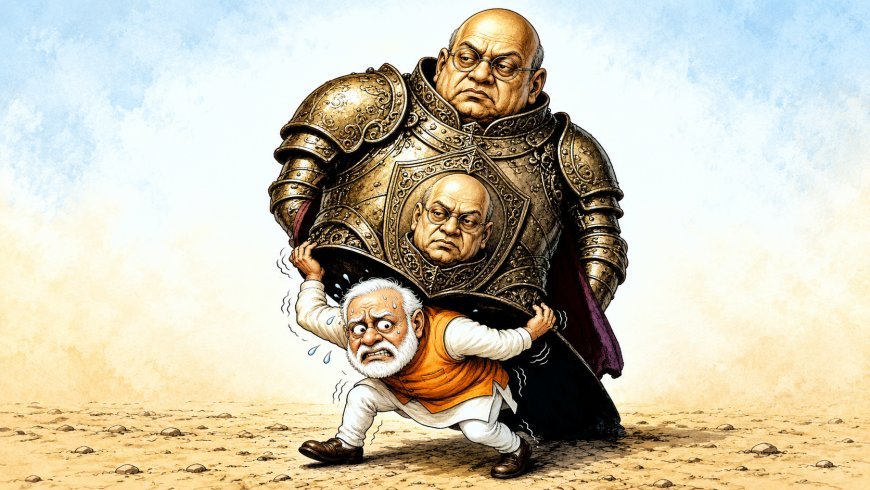
In the vast and complex theatre of Indian politics, the partnership between Prime Minister Narendra Modi and Home Minister Amit Shah is unprecedented. Often described as the ‘Jai and Veeru’ of the ruling Bharatiya Janata Party, their political journeys are so deeply intertwined that it is nearly impossible to imagine the success of one without the other. However, as the government faces increasing scrutiny over institutional independence, a pressing question has emerged among political analysts and critics: Is Amit Shah’s deeply controversial past and polarising image becoming a 'tragic flaw' for Narendra Modi during challenging political times?
To understand this critique, one must look at recent legislative actions, historical baggage, and the sheer dependency the Prime Minister appears to have on his second-in-command.
The Selection Panel Controversy
The debate recently reached a boiling point over the appointment process for the Election Commission of India. In a landmark judgement, the Supreme Court had previously ruled that the Chief Election Commissioner and other commissioners should be appointed by a panel comprising the Prime Minister, the Leader of the Opposition, and the Chief Justice of India (CJI). This was seen as a massive step towards ensuring the absolute neutrality of the election watchdog.
However, the Parliament passed a new law replacing the CJI on the panel with a Union Cabinet Minister nominated by the Prime Minister. When Amit Shah occupies such critical spaces in selection committees, it immediately triggers a storm of criticism. For the opposition and civil society, removing the highest judicial officer of the country to make way for a politician with a highly polarising track record is seen as a direct blow to institutional integrity. Critics argue that if the Prime Minister had chosen an alternative, less controversial senior minister, the public outcry might not have been as severe. The optics of having Shah- a man who the opposition constantly accuses of strong-arm tactics- on a panel meant to guarantee free and fair elections, has provided endless ammunition to the government’s detractors.
The Weight of History
To understand why Amit Shah generates such intense resistance, one must look at his political and legal history. Unlike many traditional politicians who climb the ladder through diplomatic manoeuvring, Shah’s rise was forged in the gritty, often ruthless machinery of Gujarat state politics.
His past is heavily burdened with severe legal controversies. The most prominent among these was the Sohrabuddin Sheikh alleged fake encounter case. During the investigation, Shah faced intense legal scrutiny, arrest, and even a period of exile (tadipar) from his home state of Gujarat directed by the courts.
While it is a matter of judicial record that a special CBI court discharged Amit Shah in 2014, citing a lack of sufficient evidence, the political stigma has never fully washed away. In the court of public opinion—especially among the opposition and minority groups—the acquittals are frequently viewed with suspicion. For critics, the rapid clearing of these charges once the government changed at the Centre remains a point of deep discomfort. This historical baggage makes Shah an easy target for opponents, who constantly remind the public of his past to question the moral authority of the Modi government.
The Defender-in-Chief
Despite this heavy baggage, Modi’s reliance on Shah is absolute. Perhaps nothing illustrates this better than the 2016 controversy surrounding the Prime Minister’s educational qualifications. When the opposition, led by the Aam Aadmi Party, launched a relentless campaign alleging that Modi’s university degrees were fabricated, the Prime Minister did not address the issue himself. Instead, it was Amit Shah who took centre stage.
In a highly publicised press conference, Shah presented the degrees to the media. Beside him sat Arun Jaitley, the late former Finance Minister and a man known for his urbane, sophisticated legal mind. To many political observers, Jaitley looked visibly uncomfortable, forced by party discipline to share a stage and echo a defence led by Shah. This moment was highly symbolic. It showed that when it came to defending the Prime Minister’s personal honour, Modi trusted Shah above all others to do the heavy lifting, even if it meant sidelining the party's more universally respected moderates.
The 'Tragic Flaw' vs The 'Chanakya' Narrative
In literary tragedies, a 'tragic flaw' is a trait in a leader that ultimately leads to their struggle or downfall. Is Amit Shah this flaw for Narendra Modi?
Assessments of political figures are inherently subjective and depend largely on diverse political perspectives. To his critics, Shah is undeniably a liability. Prime Minister Modi has spent a decade carefully crafting an image of a global statesman—a leader of the G20, a moderniser, and a visionary. Yet, every time the government takes a controversial step domestically, it is Shah who is seen as the enforcer. His aggressive rhetoric during state elections, his hardline stance on issues like the Citizenship Amendment Act (CAA), and his reputation for political ruthlessness often shatter the polished image Modi tries to project globally. Critics argue that without Shah’s aggressive posturing, the Modi government might face less friction from the intelligentsia, the international press, and moderate voters.
However, from the perspective of the BJP’s internal workings, calling Shah a "flaw" fundamentally misunderstands his role. For the ruling party, Shah is the modern-day 'Chanakya'. He is the ideological anchor, the master strategist who wins impossible elections, and the shield who absorbs the political heat so the Prime Minister can remain above the fray. Modi’s reliance on Shah is not necessarily a sign of weakness, but a calculated division of labour. Modi provides the charisma and the mass appeal; Shah provides the organisational ruthlessness required to turn that appeal into raw power. The Prime Minister has chosen his co-pilot, fully aware of the turbulent weather his past brings, deciding that the destination is worth the rough ride.
In a democratic setup, public perception is as important as legal reality. The fact remains that Amit Shah brings a unique set of vulnerabilities to the Modi government. His history of legal troubles and his uncompromising brand of politics make him a highly polarising figure. When he is placed in sensitive institutional roles- such as on the panel to select election commissioners- it inevitably raises questions about fairness and propriety.
Whether Amit Shah is Modi’s ‘extra tragic flaw’ or his indispensable engine will be answered by the political consequences now rippling across the nation. Until then, the truth is absolute: they govern as one single political entity.
To his supporters, Shah is the indispensable ‘Chanakya’, the master strategist who translates Modi’s mass appeal into electoral dominance and champions their era as a definitive shift to a ‘politics of performance’. Yet, to his detractors, Shah’s controversial past and polarising tactics provide relentless ammunition, with critics frequently framing the duo as harmful to India’s institutional framework. Today, Shah operates as both Modi’s strongest political shield and his heaviest reputational burden. Only the unforgiving lens of history will decide which identity ultimately defined their partnership.
What's Your Reaction?