






















First among Equals : The CEC’s Veto is only a Myth


The bedrock of any vibrant democracy rests on the absolute impartiality and unassailable credibility of its electoral referee. In India, the Election Commission has long been revered as a fiercely independent institution, capable of staring down powerful executives to ensure a level playing field. However, recent developments concerning internal discord and questions over its appointment process have cast an uncomfortable spotlight on the ‘Nirvachan Sadan’, raising critical questions about the health of India’s electoral machinery.
Echoes of Dissent
The ECI functions on the principle of consensus, or at the very least, majority agreement among its three members. The Chief Election Commissioner is constitutionally designated as the ‘first among equals’, a role intended to provide leadership, not dictatorial authority. Yet, a recent investigative report has exposed significant fault lines within the Commission.
Election Commissioners Sukhbir Singh Sandhu and Vivek Joshi have reportedly placed their objections on record at least 14 times over a ten-month period regarding decisions made during the Special Intensive Revision (SIR) of electoral rolls. Their concerns were not trivial administrative quibbles; they struck at the heart of voter enfranchisement. The dissenting notes highlighted issues such as the unilateral addition and deletion of names, the centralisation of electoral roll software, and changes made to voter registration forms, which one Commissioner reportedly described as ‘unauthorised and illegal’.
This internal friction points to a concerning dynamic. If the CEC, currently Gyanesh Kumar, is perceived to be overriding his colleagues or making critical decisions without full collegiate consultation, it undermines the very rationale for a multi-member body. The transition from a single-member Commission to a three-member body in the 1990s was precisely to prevent the concentration of power and ensure that diverse viewpoints shape electoral management. When the ‘first among equals’ operates as a solitary executive, the institutional safeguards designed to protect the Commission’s neutrality are severely compromised.
The Executive’s Shadow and the Role of Judiciary
The current crisis cannot be viewed in isolation from the controversial manner in which the present Commission was constituted. For decades, the appointment of Election Commissioners was the sole prerogative of the Executive, a system that naturally invited suspicions of political patronage. The 2023 landmark judgment in the ‘Anoop Baranwal v. Union of India’ case, a Constitution Bench of the Supreme Court sought to rectify this vulnerability.
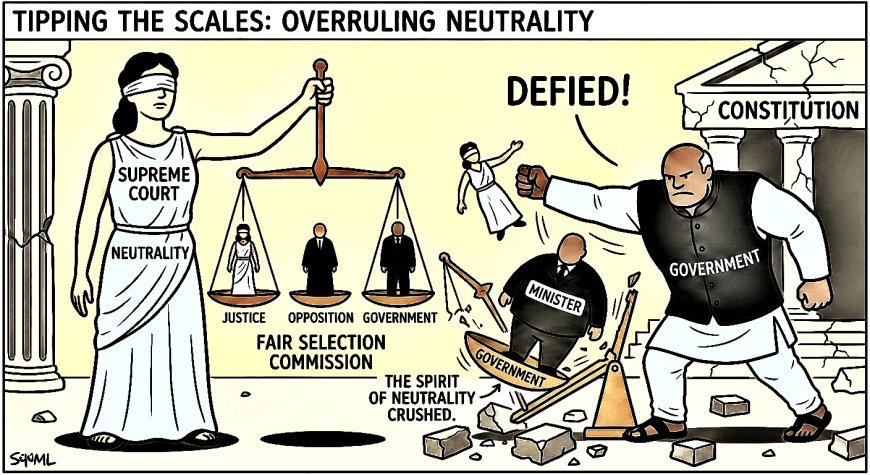
To insulate the ECI from executive influence, the Court ordered that appointments be made by a selection committee comprising the Prime Minister, the Leader of the Opposition, and the ‘Chief Justice of India’. This was intended as a temporary measure until the Parliament enacted a law. However, the legislative response was a brazen dismissal of the Supreme Court’s reasoned ruling to ensure neutrality. The hurriedly enacted law threw out the CJI to the garbage yard and brought in a cabinet colleague of the prime minister who would never dare put his foot down in dissent. The arrogant, partial executive merrily subverted the Court’s noble spirit of being impartial.
The new law strategically removed the CJI from the selection panel, replacing the judicial head with a Union Cabinet Minister nominated by the Prime Minister. This legislative manoeuvre restored the Executive’s 2-1 majority on the committee, effectively rendering the presence of the Leader of the Opposition a mere formality.
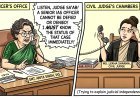
What followed was equally troubling. Despite the blatant circumvention of the Court’s intent to secure an independent appointment mechanism, the Supreme Court did not take suo motu cognizance of the altered composition. It took subsequent petitions to force a judicial review, leading to a recent split verdict by a two-judge bench on whether the new law meets the ‘perception test’ of independence. When petitioned to examine the 2023 law altering the Election Commission's selection process, a two-judge Supreme Court bench delivered a split verdict. Justice Dipankar Datta sought to issue a final ruling, strongly criticising the Chief Justice of India’s exclusion. He noted that replacing the CJI with a Cabinet minister hands the executive an unfair 2:1 majority as the Leader of the Opposition becomes a ‘doll in the shelf’ thereby badly failing the ‘perception test’ of independence.
Conversely, Justice Satish Chandra Sharma declined to rule on the merits. He maintained that the new statute, and its exclusion of a neutral constitutional functionary, raised substantial legal questions strictly requiring a five-judge Constitution bench under Article 145(3). Given this fundamental divergence over procedure, the matter has been referred to the Chief Justice to constitute a larger bench, which of course is a waste of time. Justice Datta has proven to be a truly prudent judge whereas Justice Sharma has chosen to be in the good books of the Executive which, insiders say, is likely to extract a favourable verdict from the CJI Suryakant-headed larger bench.
The initial judicial restraint in the face of the executive defia
nce allowed the new appointments, including that of CEC Gyanesh Kumar, to proceed under a cloud of systemic bias.
The Legacy of T.N. Seshan and the Path Forward
The current scenario stands in stark contrast to the legacy of those who built the ECI’s formidable reputation. The most prominent example is T.N. Seshan, the 10th CEC.of India. Before Seshan, the ECI was often viewed as a toothless tiger, compliant with executive wishes. Seshan fundamentally transformed the institution, ruthlessly enforcing the Model Code of Conduct, cancelling elections where rigging occurred, and demonstrating that the ECI derived its power from the Constitution, not the government of the day. He showed that a CEC’s strength lies not in bypassing colleagues, but in unyielding adherence to the law and a fearless independence from political pressure.
Similarly, figures like J.M. Lyngdoh, who steadfastly refused to hold early elections in Gujarat in 2002 despite immense political pressure, citing the unconducive environment following the riots, demonstrated the courage required of the office. These individuals understood that their primary duty was to the voter and the Constitution, not the appointing authority.
The current turmoil within the ECI, coupled with the Executive’s tightening grip on its composition, presents a profound challenge to India’s democratic architecture. When the referees are perceived to be compromised- either by internal autocracy or external influence- the legitimacy of the entire electoral process is jeopardised.
The immediate imperative is for the ECI to address the internal dissent transparently and reaffirm its collegiate functioning. More broadly, the ongoing judicial scrutiny of the appointment process must result in a framework that genuinely insulates the Commission from executive dominance. India’s democracy is too precious to be left to a fractured Commission or a compliant referee; it demands an Election Commission that is not only independent but unequivocally seen to be independent.
What's Your Reaction?