
























The Fast-Track Illusion: Why Justice Needs an Overhaul, Not a VIP Lane

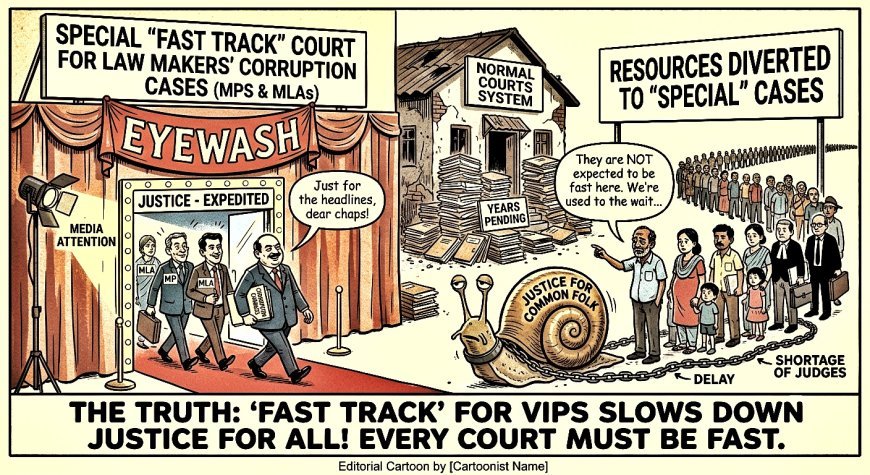
On December 12, 2017, the central government agreed to set up special fast-track courts to expedite trials of criminal cases against MPs and MLAs of the country. This happened only because an advocate called Ashwini Upadhyay filed a PIL in the Supreme Court asking for a lifetime ban on convicted politicians and speedy trials for pending criminal and corruption cases against lawmakers. The Supreme Court was forced to note that thousands of cases against legislators had been pending for decades, clogging the justice system. The corrupt and erring law makers kept enjoying immense benefits and luxury without any fear of losing status or being tossed into prison cells as the long pending criminal cases against them hardly came up for hearing. So in 2017, the Supreme Court ordered the central government to set up special fast-track courts to exclusively handle and expedite trials against sitting and former MPs and MLAs. The whole thing looked like a victory for accountability.
However, on closer look, a deeply disturbing reality shows up: Nothing really impressive is happening as the courts are truly not fast enough to decide cases as soon as expected. Political crooks are still having a nice time. And as promised, the Supreme Court is perhaps incapable of monitoring cases. Most significantly, creating a dedicated ‘fast lane’ for a select few, we are implicitly validating the agonising, soul-crushing gridlock of our regular judicial system.
The moment a specialised fast-track court is born, the ‘normal’ courts are handed a silent excuse to become slow, easygoing, and lethargic. It is as if speed, efficiency, and the timely delivery of justice are no longer mandatory for the rest of the country, but rather a special feature reserved only for high-profile cases.
This cannot stand. It is high time every single court and tribunal in the country became, by mandate, a fast-track court.
The wise citizen knows that justice delayed is justice denied. Yet, we have normalised a system where civil and criminal cases rot in judicial purgatory for decades. Creating a handful of speedy courts for politicians is only a ‘Band-Aid’ on a gaping wound. It creates a two-tiered system of justice: one where headlines dictate urgency, and another where the common citizen is left waiting a lifetime for resolution.
All litigants do need a completely fast-tracked judicial system. The high-speed courts for big people will not improve the fate of the common folks.
The government in consultation with the top constitutional courts must introduce a concept of radical accountability, that has been utterly absent from our judiciary: Perform or Perish: If courts remain perpetually slow, the judges presiding over them must lose their jobs. The judiciary cannot be a lifetime sinecure for those who fail to deliver timely verdicts. A judge’s primary duty is the swift administration of justice; failing at this is failing at the job.
Zero Tolerance for Delay: Adjournments on flimsy grounds- unprepared lawyers, absent witnesses, or mere inconvenience- must no longer be tolerated. Such adjournments should be officially classified as a dereliction of duty by the presiding judge.
Training for Speed: Newly recruited, young judges must be rigorously trained to understand that efficiency is just as important as legal acumen. The culture of judicial lethargy must be broken at the academy level before these young minds ever take the bench.
The root of our judicial backlog often lies in the endless cycle of appeals. We treat trial courts as mere stepping stones in a decade-long journey to the Supreme Court. This must end.
Trial courts have to become incredibly fast, deeply competent, and highly authoritative arenas of justice. The judgments handed down by trial courts must be considered final. Superior courts and appellate bodies must be fiercely protected from frivolous appeals, stepping in only when there is a massive, glaring legal flaw or a severe miscarriage of justice. Keeping the superior courts free of routine appeals will ensure they can focus on matters of profound constitutional and legal importance.
Fast-tracking the trials of corrupt politicians is a noble goal, but it is entirely meaningless if the wider justice system remains fundamentally broken. Justice should not have a VIP lane. Until the day a common citizen can walk into a regular civil court and expect a swift, final, and fair resolution, any ‘fast-track’ initiative is just a public relations stunt. The entire machine has to be efficiently fast, or replace the operators who cant keep pace.
The administration of justice belongs to the courts, yet the judiciary has allowed the executive to usurp its domain in most critical cases. This silent complicity has paved the way for systemic institutional capture. The discarding of the CJI from the panel that selects election commission members, is a frightening example of surrender by the judiciary to the Executive. A judiciary that allows itself to be sidelined, dictated to, and stripped of its democratic oversight roles is a judiciary that can never truly deliver justice to the ordinary citizens of India. The monitoring of the fast track courts is most likely to be a nominal and lax exercise by the top judiciary.
Against this backdrop of compromised authority, the fast-track court proposal is just a gimmick. The moment a specialised fast-track court is born, the ‘normal’ courts are handed a silent excuse to become slow, easygoing, and lethargic. It is as if speed and efficiency are no longer mandatory for the rest of the country. It is high time every single court and tribunal in the country became, by mandatory requirement, a fast-track court.
To reclaim its power and serve the citizens, the judiciary must introduce radical internal accountability on the basis of ‘Perform or Perish’.
The Bottom Line
Fast-tracking the trials of corrupt politicians means nothing if the wider justice system remains fundamentally broken and subservient to the government. Justice should not have a VIP lane, and the judiciary should not take its marching orders from the executive. Until the courts reclaim their independence and ensure a common citizen can walk into a regular civil court and expect a swift, final resolution, any ‘fast-track’ initiative is just smoke
and mirrors.
What's Your Reaction?