





























Mining the Constitution: How the 2026 MMDR Bill Strikes at Fiscal Federalism

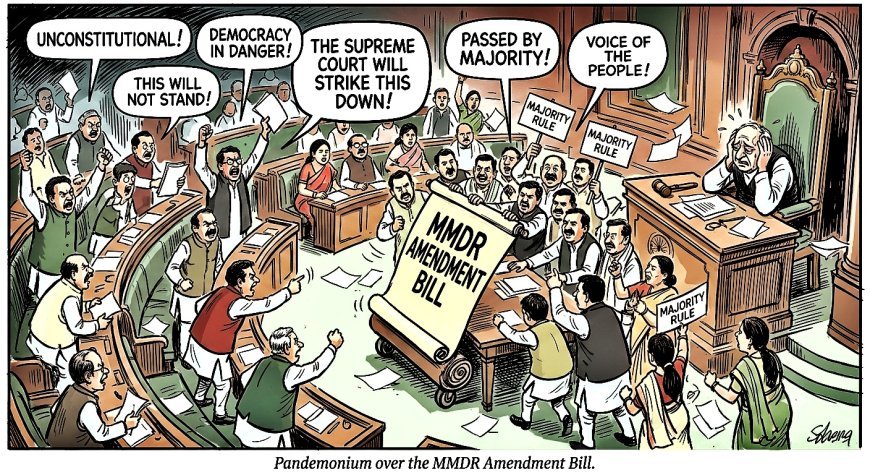
One of the biggest constitutional debates has been sparked by the passage of the Mines and Minerals Development and Regulation Amendment Bill of 2026. The issue has indeed triggered a massive showdown over the balance of power between the Centre and the States.
The political manoeuvring to pass the bill was undeniably swift and strategic. However labeling it ‘grossly illegal’ is legally complex. A straightforward breakdown of the facts, the constitutional friction, and why the Centre pushed it through will make the controversial move clear : The entire controversy stems from a landmark Supreme Court ruling on July 25, 2024. A 9-judge Constitution Bench ruled (in an 8:1 majority) that state governments do have the constitutional power to tax mineral rights and mineral-bearing lands, independent of the Centre’s royalties. The Court even allowed states to collect these taxes retrospectively dating back to April 2005. To counter this, the Centre introduced the 2026 MMDR Amendment Bill to statutorily prohibit states from imposing these specific levies. It effectively overrides the financial impact of the Supreme Court’s decision, wiping out an estimated 1.5 to 2 lakh crore rupees in retrospective dues that mining companies would have owed to states. When the states had raised objection to the very idea of the strange act, the centre put up a vague and illogical argument to justify the violation of the Federal Spirit.
The political opponents and leaders from mineral-rich states have said emphatically that the centre’s encroachment on state autonomy and fiscal federalism is grossly unconstitutional. Under the Constitution, states have the authority to tax lands and mineral rights (Entries 49 and 50 of the State List). Critics argue the Centre is overstepping by using its regulatory powers (Entry 54 of the Union List) to completely block a state’s right to generate revenue.
States like Odisha, Jharkhand, and Chhattisgarh argue that they bear the heavy environmental degradation, pollution, and displacement costs of mining. Taking away their ability to tax these resources leaves them with the damage but not the financial benefits. Leaders like Kerala’s Chief Minister have explicitly called it a violation of the Constitution’s basic principles.
Despite the uproar, the Centre argues that this wasn’t a power grab at all, but an urgent economic intervention to prevent a national supply chain crisis :
Preventing Inflation: Union Mines Minister G. Kishan Reddy argued that if 11 different states began levying heavy, retrospective taxes, the cost of core minerals (iron ore, coal, bauxite) would skyrocket. This would directly inflate the cost of cement, steel, and energy- ultimately raising the cost of living and infrastructure for the common citizen.
Investor Trust: The Centre argued that forcing mining companies to pay two decades’ worth of unexpected retrospective taxes would bankrupt businesses, erode investor trust, and force India to rely more on imported minerals.
Parliament has the legislative authority to amend laws.
However, the constitutional validity of the act is highly questionable. The Parliament’s power to legislate is not absolute and cannot be exercised on a whim. All laws must align entirely with Constitutional provisions. Therefore, the MMDR Act is bound to face Supreme Court scrutiny. With the Centre-State separation of powers clearly at issue, the apex court is very likely to strike it down. Because the bill attempts to restrict taxation powers explicitly granted to states under the State List, the state governments will be forced to challenge the new law in the Supreme Court which will strike down any act passed in violation of the basic principles as enshrined in the Constitution.
Until the Supreme Court reviews the new 2026 Act and decides whether Parliament overstepped its constitutional boundaries, the law remains in effect. It is a classic example of legislative hardball, prioritising national economic stability over regional fiscal autonomy.
It is evident that the Centre’s encroachment on state autonomy is not just overreach, but a direct constitutional violation :
Overstepping Legislative Competence: Under the Constitution, states have the authority to tax lands and mineral rights (Entries 49 and 50 of the State List). The Supreme Court explicitly affirmed that mineral-bearing land falls under Entry 49. Thus the Centre is brazenly overstepping by using its regulatory powers (Entry 54 of the Union List) to completely block a state’s right to generate revenue from its own land.
Violation of Article 14 (Equality): The new bill attempts to extinguish unpaid past dues but explicitly refuses refunds to companies that have already paid. Treating entities differently based merely on whether they delayed their tax payments or complied early is a potential violation of the fundamental right to equality under Article 14 of the Constitution.
Breach of Separation of Powers: Parliament is attempting to retrospectively nullify a Supreme Court verdict. While Parliament has the legislative authority to amend laws, established legal precedent dictates it cannot simply “override” a judicial decision without altering the fundamental legal basis that led to the ruling. Doing so threatens the separation of powers, a core pillar of the Constitution.
The Supreme Court’s Crucial Test
Ultimately, the constitutional validity of this amendment is highly questionable. Because the bill attempts to restrict taxation powers explicitly granted to states under the State List, state governments are preparing to challenge the new law in the Supreme Court.
The apex court now faces a defining test of its own authority. To uphold the Constitution, the Court must apply the Doctrine of Colourable Legislation- the principle that a legislature cannot do indirectly what it lacks the power to do directly. The Court will have to heavily scrutinise whether this bill legitimately alters the tax framework, or if it is an unconstitutional workaround to bypass judicial authority and centralize revenue. If the Court strikes down the amendment, it will be to defend the basic structure of the Constitution, ensuring that the separation of powers is respected and that the fiscal autonomy of the states- and by extension, the welfare of regional citizens- is not jeopardized by central overreach.
Until the Supreme Court reviews the new 2026 Act, it remains a classic example of untenable aggressive legislative tactics, prioritising national economic control over regional fiscal autonomy.
What's Your Reaction?