



























FAITH, FEAST, AND ENFORCEMENT: INSIDE ODISHA’S COMPLEX KARTIKA VEGETARIAN DEBATE



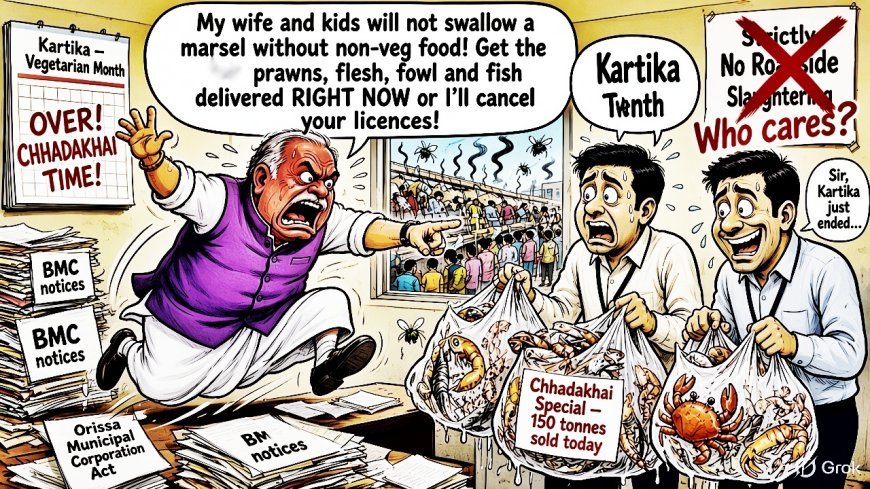
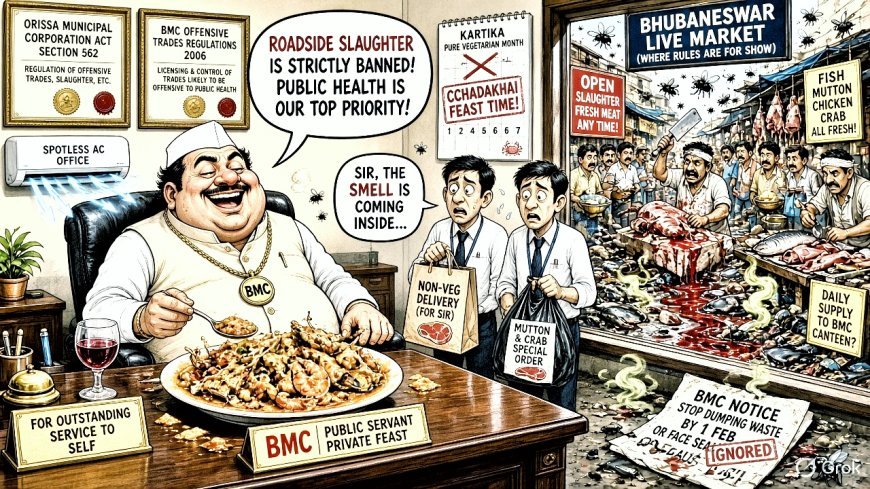

When Feasting Appetite at the Top is Insane, Enforcers Queue at Illegal meat Stalls and Civic Officials ignore Accountability..
Every autumn, Odisha enters a striking cultural contrast. Throughout the lunar month of Kartika, thousands of devout households- especially the elderly women known as Habishyalis, observe austere vegetarian diets, dawn baths, and temple rituals. Yet across cities like Bhubaneswar, meat and fish markets continue to operate briskly during the same so-called sacred period , culminating in ‘Chhadakhai’, the massive post-Kartika feast where local media estimated Bhubaneswar residents spent nearly 8.69 crore to 9 crore rupees on non-vegetarian food in a single day on 25, November 2026.
This visible gap between sacred restraint and booming meat consumption has sparked recurring debate across Odisha. Critics argue that the month-long vegetarian observance has become a hollow ritual undermined by unchecked appetites, open roadside slaughtering, and lax municipal enforcement. Defenders of Odisha’s culinary traditions, however, maintain that dietary choices are personal, rooted in coastal livelihoods and family custom, and should not be policed through moral shaming.
Scripture, Custom, and Voluntary Vow
A common question in public discussions is whether Kartika vegetarianism even has a basis in Hindu texts. Contrary to claims that no scripture mentions it, religious records and state publications explicitly document the tradition. According to the ‘Kartika Mahatmya’ section of the ‘Skanda Purana’ (Vaishnava Khanda), devotees are advised to abstain from meat and even fermented preparations during the month of ‘Kartika’. Similarly, articles published in the Odisha government’s Orissa Review cite the ‘Kartika Purana’, ‘Skanda Purana’, and ‘Padma Purana’ to describe ‘Kartika Brata’- a month of strict spiritual discipline involving ‘Habishanna’ (a single simple meal of raw rice, specific vegetables, and cow ghee without onion, garlic, or turmeric), lighting the ‘Akasha Deepa’, and practising compassion towards all living beings.
Even so, religious scholars emphasise that Hindu practice treats Kartika dietary restrictions as a voluntary vrata (vow) based on individual resolve (sankalpa) and family custom (kula achara), rather than a binding law for every resident. Some Odia religious commentators, including astrologer Pandit Niranjan Mohapatra in local media discussions, have explicitly stated that eating non-vegetarian food during Kartika does not constitute a sin for those who have not undertaken the formal vow.
Incidentally, the ‘Kartika abstinence’ is not unique to Odisha alone. Hindu communities across Andhra Pradesh, Telangana, Karnataka, and parts of northern India also avoid meat, fish, and eggs during the month, following the lunar calendars. What makes Odisha distinctive is ‘Chhadakhai’- literally meaning ‘to leave and eat’ on the celebratory day immediately following Kartika Purnima when families gather to resume eating fish, prawns, mutton, and chicken.
Ecology, Fish Breeding, and Seasonal Realities
Many citizens link Kartika vegetarianism to environmental conservation, particularly the belief that giving up fish protects breeding species from extinction. Ecological and seasonal explanations do play a role in traditional Indian calendars, though scientific and regulatory timelines show a more nuanced picture.
According to the Odisha Fisheries Department, the state’s official two-month marine fishing ban, imposed under the Odisha Marine Fishing Regulation Act of 1982 specifically to protect marine fish stocks during spawning and breeding, takes place from 15 April to 14 June, not during Kartika. However, conservation efforts do overlap with Kartika in another crucial way: every 1 November, Odisha enforces a seven-month coastal fishing ban to protect hundreds of thousands of endangered Olive Ridley turtles arriving to mate and nest at Gahirmatha and Rushikulya.
Traditional health systems offer a separate explanation. Classical Ayurvedic texts such as the ‘Charaka Samhita’ advise eating light meals and avoiding aquatic meats during autumn, and local commentary in Orissa POST notes the traditional view that human digestion weakens during this seasonal transition, making vegetarian food easier to process.
At the same time, social commentators point out that Odisha’s rural food history was never uniformly vegetarian during Kartika. Writing in The Wire in November 2026, author Radha Kant Barik observed that the post-monsoon Kartika season historically brought abundant fish and relatively few vegetables to Odisha’s villages, suggesting that stricter, wider abstention from fish in rural areas reflects more recent cultural and political shifts rather than an unbroken ancient norm.
Market Reality: Between Abstinence and Chhadakhai
On the ground, Odisha remains overwhelmingly non-vegetarian in its everyday diet. State government figures reported by The Times of India in November 2026 show that Odisha’s annual fish consumption reached 9.46 lakh tonnes in 2025–26 against state production of 12.71 lakh tonnes, with freshwater fish still imported from neighbouring states like Andhra Pradesh to meet high local demand.
Even while many households keep vegetarian kitchens during Kartika, local Odia news reports in November 2026 highlighted that fish, chicken, and mutton markets remained active and expensive throughout the month. Critics view this trend- where some family members observe strict rituals at home while others quietly eat meat outside- as social hypocrisy. That tension becomes most visible on Chhadakhai. On 25 November 2026, Kalinga TV, Sambad English, and OTV reported heavy morning queues at Bhubaneswar’s Unit-IV Market, Kochilei Haat, Jharpada, Balakati, and Patia, with shoppers purchasing an estimated 150 tonnes of fish, prawns, and crabs despite steep prices- mutton selling around Rs 1000 per kg, prawns at Rs 800 per kg, and hilsa reaching up to Rs 2000 per kg.
For animal-welfare advocates and ecologically minded critics, this frenzied binge contradicts the restraint Kartika is meant to teach. For traders, fishers, and many Odia families, however, Chhadakhai is simply a joyful social tradition and an essential economic lifeline for thousands of small vendors.
Open Slaughtering, Civic Laws, and Political Accountability
Where both critics and many ordinary non-vegetarian residents find common ground is the poor regulation of meat markets and open roadside slaughtering in Bhubaneswar.
On paper, Odisha has clear legal controls. Under Section 562 of the Orissa Municipal Corporation Act, 2003, roadside slaughtering of animals within municipal limits is completely banned, while the Bhubaneswar Municipal Corporation (BMC) Offensive and Dangerous Trades Regulations, 2006 mandate valid municipal licences for all meat shops. In January 2026, BMC also issued a public directive ordering all fish, meat, and poultry vendors, with special focus on Unit-I and Unit-IV markets, to stop dumping waste in open drains, roads, and vacant plots by 1 February 2026, warning of licence cancellations and sealing of shops to protect public health and aviation safety.
In practice, enforcement has lagged behind the law. Reports in The New Indian Express and The Times of India have repeatedly documented persistent open slaughtering across Bhubaneswar, alongside complaints from residents about foul smells and unsanitary lanes. Meat traders themselves have pointed out that BMC promised ward-level wet markets years ago and struggled for over a decade to make its mechanised modern abattoir at Gadakana fully functional, prompting the civic body to float a fresh operational bid in January 2026.
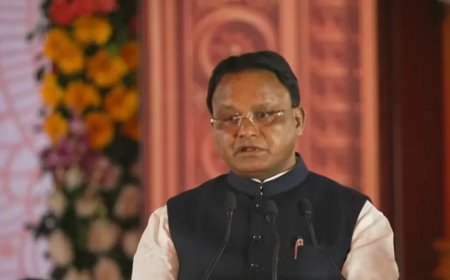
Public frustration over civic enforcement frequently extends to Odisha’s political leadership. Supporters note that Chief Minister Mohan Charan Majhi has publicly honoured Kartika traditions, personally distributing Kartika Brata essentials to Habishyalis in Puri and describing the observance as a symbol of mothers’ resilience. Critics, meanwhile, argue that ceremonial endorsements of religious traditions mean little if state and municipal authorities fail to enforce basic hygiene laws, curb roadside slaughtering, and operationalise modern slaughterhouses. While rumours occasionally circulate in informal discussions accusing ministers, the Chief Minister, or enforcement officials of privately flouting Kartika norms or colluding with unlicensed stalls, no verified public reports substantiate claims about the Chief Minister’s personal diet or systematic collusion by municipal staff. Rather, civic observers trace the breakdown primarily to infrastructure delays and inconsistent municipal monitoring.
Shaping Future Generations: Hygiene, Empathy, and Balance
Beneath the heated arguments over Kartika lies a deeper concern about what urban Odisha’s streetscapes and habits teach children. Critics warn that exposing young minds daily to unhygienic, open-street slaughtering normalises bloodshed, dulls empathy for animals, and fosters careless consumption that harms nature. Even many meat-eating residents agree that open slaughtering near homes and schools has no place in a modern capital city.
At the same time, nutritionists, sociologists, and fishing communities caution against equating all non-vegetarian diets with cruelty or environmental destruction. Sustainable fisheries, regulated abattoirs, and hygienic wet markets allow coastal societies to maintain traditional diets and livelihoods while protecting wildlife and public sanitation.
Ultimately, Odisha’s Kartika debate is less about forcing every citizen into a single diet and more about honesty and civic discipline. Respecting both spiritual heritage and ecological responsibility requires honest personal choices, strict enforcement of municipal laws against open slaughtering, functional modern abattoirs, and genuine conservation of marine and river ecosystems, standards that protect both nature and the values passed on to the next generation.
What's Your Reaction?