



























LAW, LOGIC, AND REBELLION: THE TWO PATHS TO FIXING THE INDIAN JUDICIARY



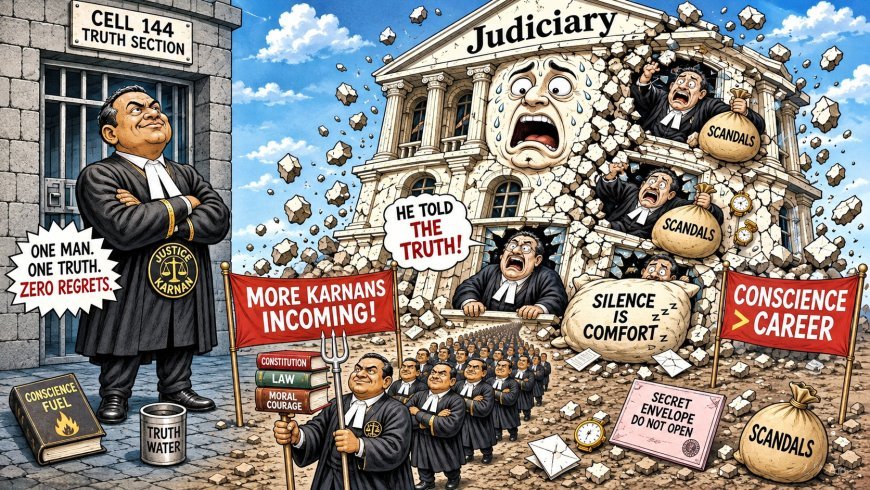

Five days ago, the judiciary's greatest maverick died in near obscurity. Following his passing in Chennai, Justice C.S. Karnan was laid to rest on November 14 in his native Karnatham—a remarkably quiet end for a man who once waged open warfare against the highest courts in the land. Though he vanished from the public eye after his unceremonious retirement in June 2017, he remains the only judge to have shaken the establishment to its core by publicly indicting its supreme bosses. His demise marks the definitive, silent close of a deeply turbulent era of judicial defiance.
Picture a most magnificent scene. A man walks out of a prison gate with absolute, unshakable dignity. He is wearing a sharp, formal coat, holding his head high, and commanding the magnetic aura of a film star. This is Justice Chinnasamy Swaminathan Karnan. But he was not walking out of a film set, nor was this a dramatic scene from a political thriller. He was walking out after serving a six-month sentence in a jail cell for the ‘crime’ of contempt of court. He was the first Dalit judge of the Madras High Court, and he made history again as the first sitting judge of a High Court in India to serve a prison sentence while still in office.
For budding lawyers and law students reading this across the country, this striking image is not just a piece of trivia for a competitive examination. It is a profound, living lesson in what happens when a single man dares to hold a mirror to a powerful, opaque institution. Justice Karnan is no ordinary legal figure. He was a man who understood the struggles of the common citizen, but his true legacy was cemented in 2017 when he did the unthinkable- he broke the judiciary’s unwritten code of silence.
The Catalyst: A Whistleblower in the Temple of Justice
There is a vital reason to analyse Justice Karnan’s actions today. In early 2017, he wrote a formal letter to the Prime Minister of India, Narendra Modi. This was no routine administrative correspondence. It contained a detailed, explosive list naming twenty corrupt judges. It was an insider blowing the whistle on the very temple of justice. For the first time in the long history of independent India, a sitting judge had levelled specific, documented allegations of corruption against his own judicial peers.
In any functioning, transparent democracy, such a letter from a high constitutional authority would trigger an immediate, high-level, independent investigation. It would prompt a fierce national debate on accountability and the integrity of democratic institutions. But the system was terrified. The central government and the judicial machinery were simply not prepared to make that letter public or investigate its contents. The establishment realised that if the rot was exposed, the entire edifice of the judicial hierarchy might be compromised in the eyes of the public.
Instead of investigating the grave claims, the system decided to shoot the messenger. The Supreme Court of India swiftly initiated contempt of court proceedings against Justice Karnan. The law of contempt, originally a colonial-era legal concept designed to protect the majesty of the courts, was weaponised to protect the brotherhood of judges from public scrutiny. The message sent to the nation was chillingly clear: the institution must not be questioned, and transparency must not be demanded.
Two Paths to Accountability: Shah and Karnan
To fully grasp the magnitude of this confrontation, one must understand how the apex court establishment often treats gutsy judges. High Courts are independent constitutional courts under Article 226, not subordinate departments of the Supreme Court. Yet, when brave High Court judges challenge the status quo, the ‘bosses’ at the top often look down upon them as insubordinate rebels on the wrong footing of the law, denying them their due credit.
When observing the history of judicial courage, it is fascinating to place Justice Karnan on a common footing with another legal stalwart: former Chief Justice of the Delhi High Court, A.P. Shah. Both men fought to bring accountability to an opaque system, but they chose entirely different weapons:
In 2010, Justice A.P. Shah delivered a landmark, fearless judgement ruling that the office of the Chief Justice of India comes under the purview of the Right to Information Act, mandating that Supreme Court judges must declare their assets. Justice Shah fought the system from strictly within his established jurisdictional boundaries. His weapon was impeccable legal reasoning. Yet, the Supreme Court establishment was so rattled by this demand for transparency that it took the highly unusual step of appealing the verdict to itself. They stayed the order indefinitely, and never elevated the highly deserving Justice Shah to the Supreme Court bench, which caused massive public displeasure. It was only in 2019 that a Constitution Bench of the Supreme Court was finally forced to concede and uphold Justice Shah’s airtight verdict.
Justice Karnan’s path, however, was born out of sheer defiance. Deeply frustrated by a system that flatly refused to investigate his documented allegations of corruption, he decided that desperate times called for unorthodox measures. While Justice Shah used the meticulous pen of jurisdiction to force transparency, Justice Karnan deliberately crossed the constitutional line to force a national crisis.
The Unprecedented Counter-Strike
When the Supreme Court initiated contempt proceedings against him, Justice Karnan refused to be bullied into submission. He did not bow down, nor did he offer a meek apology to save his lucrative job and post-retirement benefits. Instead, exercising his own judicial authority, he passed suo motu orders against the very Supreme Court judges who were prosecuting him, indicting them as guilty under the Scheduled Castes and Scheduled Tribes (Prevention of Atrocities) Act. In a move that shook the political and legal foundations of New Delhi, he awarded them five years of rigorous imprisonment.
Legally, the hierarchy is absolute: a High Court judge cannot assume supervisory or punitive jurisdiction over sitting apex court judges. Justice Karnan’s orders were constitutionally void, but as a moral and political statement, they were a devastating strike against an untouchable brotherhood.
More importantly, the Supreme Court's reaction exposed its own heavy-handedness. Under the established framework of Indian law, if the apex court disagreed with his orders, their rightful constitutional recourse was simply to stay or overrule those judgements. That is how the appellate hierarchy is designed to function. Instead, the system bypassed standard legal procedures. Rather than just setting aside his orders, they took it upon themselves to find a sitting constitutional authority personally guilty of contempt and sent him to prison. They treated him not as a fellow judge with independent constitutional standing, but as a disobedient employee rebelling against his superiors.
The Smear Campaign and Ultimate Vindication
Justice Karnan was stripped of his judicial powers and sentenced to six months in prison. But putting him behind bars was not enough for the establishment; they felt an urgent need to completely destroy his credibility. Detractors, alongside sections of a pliant media, ran a vicious smear campaign loudly proclaiming that he had gone mad. They even attempted to officially brand him as insane through forced medical examinations—a textbook tactic used by oppressive systems worldwide to discredit whistleblowers.
But Justice Karnan stood his ground. He served his time in prison with his dignity completely intact, remaining a prisoner of conscience who refused to apologise for speaking the bare truth. Ultimately, he became a hero precisely because he refused to bow down to the bosses on any platform.
Time is a cruel judge of hypocrites, and time has thoroughly vindicated Justice Karnan. In the years following his imprisonment, the tightly sealed lid on judicial corruption blew wide open. Unaccounted-for cash worth several crore rupees was discovered at the residences of judicial officers. Scandals involving middlemen fixing judgements and manipulating benches repeatedly made national headlines. Looking at the highly questionable judgements, the arbitrary granting of bail to the powerful while the poor languish in jails, and the disturbing oral observations made by various courts in recent times, it has become painfully clear that what Justice Karnan shouted from the rooftops in 2017 was the absolute truth. He was not mad; he was simply courageous and ahead of his time.
The Real Lesson for the Future of Law
For students currently pursuing law, learning the intricacies of the Constitution and the Penal Code is only half of their education. The intertwined legacies of Justice Shah and Justice Karnan serve as a true reality check. In moot courts and classrooms, students are taught that the law is a noble, flawless profession- a blindfolded goddess weighing truth and justice on an equal scale.
However, the stark reality is that institutions are run by human beings susceptible to greed, political pressure, and the intoxication of absolute power. Future lawyers and judges will inevitably face defining moments where the law demands one thing, but the ‘system’ demands another. They will witness colleagues compromising their ethics for senior designations, lucrative corporate briefs, or comfortable government postings.
Justice Karnan understood a fundamental, undeniable truth: ‘No one but the judiciary itself can reform the judiciary.’ He made a courageous, although lonely, attempt at such a massive reform. He risked his entire career, his personal freedom, and his reputation because his conscience demanded it. Not surprisingly, he chose the harsh, cold floor of a prison cell over the comfortable silence of complicity.
Today, the nation remembers him as several clear cases of corruption vindicate his adventure. The scandals that have surfaced in the judiciary stand as an unshakeable testament to his foresight and integrity. His story, alongside that of Justice Shah, proves that voices of dissent, armed with nothing but the truth, can terrify the most powerful corridors of power. As the public evaluates the deteriorating state of democratic institutions, the path forward is crystal clear. India needs a number of Justice Karnans and Justice Shahs to fix the judiciary and the executive that is brazenly errant.
What's Your Reaction?